 +91 7550360374
  info@digitalbizstar.com
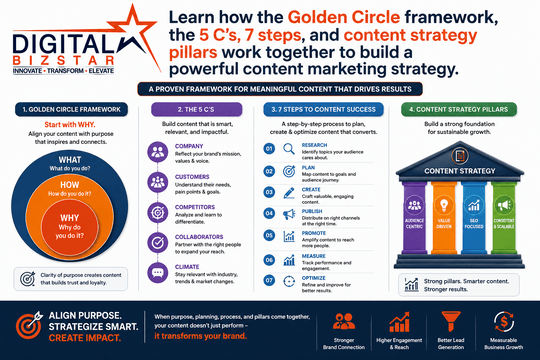
What is the Golden Circle in Content Marketing?
The Golden Circle in content marketing is a strategic framework developed by Simon Sinek that helps brands create purpose-driven content by answering three questions in order: Why, How, and What.
Most brands start with what they publish. The Golden Circle flips that approach — starting with why the content exists, which creates deeper emotional resonance and stronger audience loyalty.
The three layers:
- Why — The core purpose behind your content. Why does your brand create it? What belief or mission drives it?
- How — The strategy and process you use to deliver that purpose. Blogs, videos, email, social media.
- What — The actual content you produce and publish.
Example applied to a digital marketing brand:
| Layer | Answer |
| Why | Empower small businesses to grow without big budgets |
| How | Educational blogs, step-by-step guides, free tutorials |
| What | SEO articles, YouTube videos, downloadable checklists |
Starting with Why is what separates brands that build loyal audiences from brands that just produce content.
What is Content Marketing?
Content marketing is a long-term strategy focused on creating and distributing valuable, relevant content to attract, engage, and retain a clearly defined audience — with the goal of driving profitable customer action.
Unlike direct advertising, content marketing builds trust first and sells second.
According to the Content Marketing Institute (2024), content marketing generates three times more leads than outbound marketing while costing 62% less.
Common content formats:
- Blog posts and long-form guides
- Videos and YouTube tutorials
- Infographics and visual explainers
- Social media posts and threads
- Podcasts and webinars
- Email newsletters
What is Content Marketing in Digital Marketing?
In digital marketing, content marketing serves as the foundation that supports every other channel.
It contributes directly to:
- Organic traffic — Well-optimized content ranks on Google and brings in visitors without ad spend
- Brand authority — Consistently publishing expert content positions your brand as a trusted source
- Lead generation — Valuable content attracts high-intent users who are already researching solutions
- Social engagement — Shareable content extends your reach across platforms organically
- Email growth — Content upgrades and lead magnets convert readers into subscribers
Without a content strategy, paid ads, social media, and SEO all lose their connective tissue.
What are the 5 C’s of Content Marketing?
The 5 C’s are the five qualities that every piece of effective content must have:
1. Clarity Your message must be immediately understood. Avoid jargon. Use short sentences, clear headings, and a single focused topic per piece.
2. Consistency Publishing regularly builds audience trust and tells search engines your site is active. A content calendar is essential for maintaining consistency.
3. Credibility Back your claims with data, cite reputable sources, and demonstrate real experience. In 2026, Google’s E-E-A-T (Experience, Expertise, Authoritativeness, Trustworthiness) directly influences rankings.
4. Connection Content that triggers an emotional response — curiosity, relief, inspiration, or recognition — performs significantly better. The Golden Circle’s Why layer is what creates this connection.
5. Conversion Every piece of content should guide the reader toward a next step — a related article, a free resource, a newsletter signup, or a product page. Value first, conversion second.
What are the 7 Steps of Content Marketing?
A repeatable, structured process is what separates brands that grow consistently from those that publish randomly.
Step 1 — Set clear goals Define what success looks like. More organic traffic? More leads? More brand awareness? Each goal requires a different content approach.
Step 2 — Understand your audience Build audience personas based on real data — demographics, search behavior, pain points, and preferred content formats. Use Google Analytics and social insights.
Step 3 — Conduct keyword research Identify the exact phrases your audience types into search engines. Prioritize long-tail keywords with clear intent using tools like Ahrefs, Semrush, or Google Keyword Planner.
Step 4 — Create intent-matched content Write content that fully answers the user’s question before anything else. Match the format to the intent — informational queries need guides, transactional queries need comparison pages.
Step 5 — Distribute across channels Publishing is not enough. Share your content via email, social media, community forums, and content syndication platforms to maximize initial reach.
Step 6 — Analyze performance Track organic traffic, time on page, bounce rate, and conversions in Google Search Console and Google Analytics. Identify what is working and what is not.
Step 7 — Optimize and improve Update older content with new data, improve weak sections, add internal links, and refine headlines. Refreshing existing content is often faster than creating new content and delivers strong ranking gains.
What are the 5 Pillars of a Strong Content Strategy?
A content strategy without structure collapses under its own volume. These five pillars keep it organized and effective:
1. Planning Define your content goals, audience segments, content types, and publishing frequency before creating anything. A documented strategy performs significantly better than an undocumented one.
2. Creation Produce content that is genuinely more useful than what already ranks. Cover the topic in depth, use original examples, include relevant data, and format it for easy scanning.
3. Distribution Decide which platforms your audience uses and prioritize those. Not every brand needs to be everywhere — focused distribution outperforms scattered posting.
4. Promotion Actively promote new content through email newsletters, social media, outreach to relevant communities, and partnerships. Content that earns backlinks naturally also tends to rank faster.
5. Analysis Review performance data on a monthly basis. Use what you learn to inform future content decisions — double down on what works, cut or improve what does not.
Why is the Golden Circle Important in Content Marketing?
Most brands default to creating content about what they sell. The Golden Circle challenges that instinct by making purpose the starting point.
When you lead with Why, your content:
- Speaks to beliefs and values, not just features
- Builds emotional loyalty that paid advertising cannot replicate
- Differentiates your brand in crowded, competitive niches
- Attracts an audience that genuinely cares about what you stand for
Research by Nielsen (2023) found that purpose-driven brand content generates 2x higher engagement than purely promotional content. The reason is straightforward — people do not share content about products, they share content that reflects who they are.
Conclusion
The Golden Circle is not just a presentation framework — it is a content philosophy. When you build your entire content strategy around Why your brand exists, How you deliver that purpose, and What you actually publish, every piece of content becomes intentional and cohesive.
Combined with the discipline of the 5 C’s, the structure of the 7-step process, and the foundation of the 5 content strategy pillars, the Golden Circle gives you everything you need to build a content marketing strategy that ranks, resonates, and converts.
Frequently Asked Questions
What is the Golden Circle in simple terms? The Golden Circle is a three-layer framework — Why, How, What — that helps brands create content with a clear purpose instead of just promoting products. It was introduced by Simon Sinek in his 2009 TED Talk, one of the most-watched talks of all time.
How does the Golden Circle apply to content marketing specifically? In content marketing, Why defines the mission behind your content, How defines your format and strategy, and What defines the actual posts, videos, or guides you produce. Starting with Why ensures every piece of content serves a purpose beyond just filling a publishing calendar.
What are the 5 C’s of content marketing? The 5 C’s are Clarity, Consistency, Credibility, Connection, and Conversion. Together they ensure your content is clear, trustworthy, emotionally engaging, and drives real business results.
How long does content marketing take to show results? Organic content marketing typically takes 3 to 6 months to show measurable results in search rankings. However, email and social distribution can drive results within days. Long-term, content compounds in value — a well-optimized article can generate traffic for years.
What is the difference between content marketing and SEO? SEO is the technical and structural optimization that helps content get found. Content marketing is the strategy for creating content worth finding. In 2026, the two are inseparable — strong content marketing without SEO has limited reach, and strong SEO without quality content has nothing to rank.