 +91 7550360374
  info@digitalbizstar.com
Manufacturing Digital Marketing Agency: How to Generate More OEM Leads in 2026
Did you know? Modern OEM buyers rarely contact the first supplier they find. Instead, they compare multiple manufacturers based on technical expertise, certifications, website quality, and search visibility. Companies that invest in digital marketing are more likely to be shortlisted before an RFQ is even submitted.
Nearly 70% of B2B buyers research suppliers online before speaking with a sales representative. For manufacturers, this means your website, search visibility, and digital credibility play a critical role in winning OEM business. In this guide, you’ll discover how SEO, Google Ads, Account-Based Marketing (ABM), and a high-performing website can help you attract qualified OEM leads and drive sustainable growth in 2026.
Why OEM Lead Generation Looks Different in 2026
OEM buying decisions involve multiple stakeholders, including engineers, procurement teams, and plant managers, each searching for different information before selecting a supplier. With AI-powered search platforms like ChatGPT and Google AI Overviews influencing research, manufacturers need clear, technically accurate, and well-structured content to stay visible and earn a place on the OEM shortlist.
This shift separates a generic marketing vendor from a specialist industrial marketing agency—one that understands OEM buyers need proof of technical expertise before submitting an RFQ.
OEM Buying Journey in 2026: Understanding How Industrial Buyers Choose Suppliers
Unlike B2C purchases, OEM sourcing decisions involve multiple stakeholders, technical evaluations, and longer buying cycles. Before contacting a supplier, most OEM buyers spend significant time researching potential partners online.
A typical buying journey includes:
Buying Stage |
Buyer Activity |
Digital Opportunity |
| Problem Identification | Looking for manufacturing capabilities | Educational blogs & SEO |
| Supplier Research | Comparing manufacturers | Service pages & case studies |
| Technical Evaluation | Reviewing certifications and processes | Technical content, downloadable brochures |
| Shortlisting | Comparing pricing, expertise, and delivery | Testimonials, industry experience |
| RFQ Submission | Contacting selected suppliers | Optimized RFQ forms & fast response |
Manufacturers that provide clear technical information, industry expertise, and an easy-to-use website are more likely to make the shortlist before competitors.
1. Manufacturing SEO: Get Found by the Engineers Doing the Research
SEO is still the foundation of OEM lead generation, but it’s evolved well past keyword stuffing and generic service pages.
Focus on these four core SEO practices:
Strategy |
Benefit |
| Technical Keywords | Attract engineers |
| Solution Pages | Improve conversions |
| Technical Resources | Build trust |
| AI Search Optimization | Increase AI visibility |
AI Search Checklist for Manufacturing Companies
As AI-powered search becomes more common, manufacturers should ensure their websites are optimized for both traditional search engines and AI-generated answers.
Use this checklist:
- ✅ Answer technical questions clearly
- ✅ Organize content with descriptive headings
- ✅ Add FAQ sections to key pages
- ✅ Include product specifications and certifications
- ✅ Publish industry-specific guides
- ✅ Use structured data (Schema Markup)
- ✅ Improve page speed and mobile usability
- ✅ Keep content updated with current standards and capabilities
- These practices improve the chances of appearing in AI-generated search responses while also enhancing the overall user experience.
Done properly, Manufacturing SEO compounds — every technical page you publish keeps generating qualified traffic long after it’s live, which is exactly why it should sit at the center of any long-term OEM lead generation strategy.
2. Google Ads: Precision Targeting for High-Intent OEM Buyers
SEO builds long-term visibility, but paid search fills the gap while your organic authority grows — and it’s where a lot of manufacturers waste budget by targeting broad, generic terms. Manufacturers should prioritize commercial-intent keywords over broad informational searches to maximize qualified RFQs.
The biggest mistake in industrial PPC is bidding on vague terms like “custom fabrication” or “injection molding,” which attract browsers, not buyers. Instead:
- Bid on hyper-specific, long-tail terms tied to real specs, standards, or part numbers — the kind of search only a genuine OEM buyer would type.
- Run branded campaigns to protect your name from distributors or resellers bidding on it.
- Focus spend on your highest-margin capabilities or flagship processes, using landing pages built specifically for that campaign rather than sending traffic to your homepage.
- Track conversions past the click — form fills, spec-sheet downloads, and RFQ submissions matter more than raw traffic.
A well-run Google Ads program gives you a lever you can turn on immediately, which is invaluable when you’re trying to fill a pipeline gap while your SEO and content strategy build momentum.
3. Account-Based Marketing: Going After the OEMs You Actually Want
Not every OEM lead is worth the same. For manufacturers with a defined list of target accounts — specific OEMs in aerospace, medical, automotive, or industrial equipment — casting a wide net wastes budget that could be spent going straight after the accounts that matter.
Effective Account-Based Marketing for manufacturers typically includes:
- Building a target account list based on ideal OEM profile: industry, volume, certification requirements, and geography.
- Creating tailored content and landing pages for specific verticals — a page built for medical-device OEMs should read very differently from one built for industrial automation buyers.
- Coordinating LinkedIn outreach, retargeting ads, and email sequences aimed specifically at decision-makers within those target accounts.
- Aligning sales and marketing so that once an ABM target engages, there’s a fast, informed follow-up — not a generic “thanks for your interest” autoresponder.
ABM is most effective when sales and marketing teams work together using shared account data and engagement insights. It is slower to set up than a broad campaign, but for manufacturers chasing high-value OEM contracts, it consistently produces better-qualified conversations than volume-based lead gen alone.
4. Website Design: Your Site Is the First Plant Tour an OEM Buyer Gets
Every strategy above sends traffic somewhere — and if that destination doesn’t work, the effort behind it is wasted. For OEM buyers, your website isn’t a brochure. It’s a technical self-service tool that needs to answer questions fast, without a phone call.
A site built to convert OEM traffic should:
- Let buyers filter and search by specification, not just product category.
- Offer downloadable spec sheets, capability statements, and certifications without gating everything behind a form.
- Load fast and work cleanly on mobile — plenty of engineers are researching suppliers from the shop floor, not a desk.
- Include clear, low-friction contact and RFQ forms that don’t demand ten fields before someone can ask a simple question.
- Feature case studies and certifications prominently — OEM buyers are looking for proof you can deliver at their required tolerances, volumes, and quality standards.
- Show manufacturing certifications (ISO 9001, ISO 13485, AS9100) prominently to build buyer confidence.
Strong Website Design turns every other channel — SEO, ads, ABM, LinkedIn — into something that actually converts, instead of leaking leads at the last step.
What Makes an RFQ More Likely?
Generating website traffic is only the first step. Converting visitors into qualified enquiries depends on how easily buyers can evaluate your capabilities.
High-performing manufacturing websites often include:
✔ Product specifications
✔ Material options
✔ Industry certifications
✔ CAD drawing support
✔ Manufacturing tolerances
✔ Delivery capabilities
✔ Downloadable brochures
✔ Customer success stories
✔ Clear RFQ forms
✔ Fast page loading
The easier it is for engineers and procurement teams to find technical information, the more confident they feel about submitting an enquiry.
Manufacturing Marketing Funnel: Turning Visitors into OEM Leads
Digital marketing isn’t about generating traffic alone. The objective is to guide potential buyers through every stage of the purchasing journey.
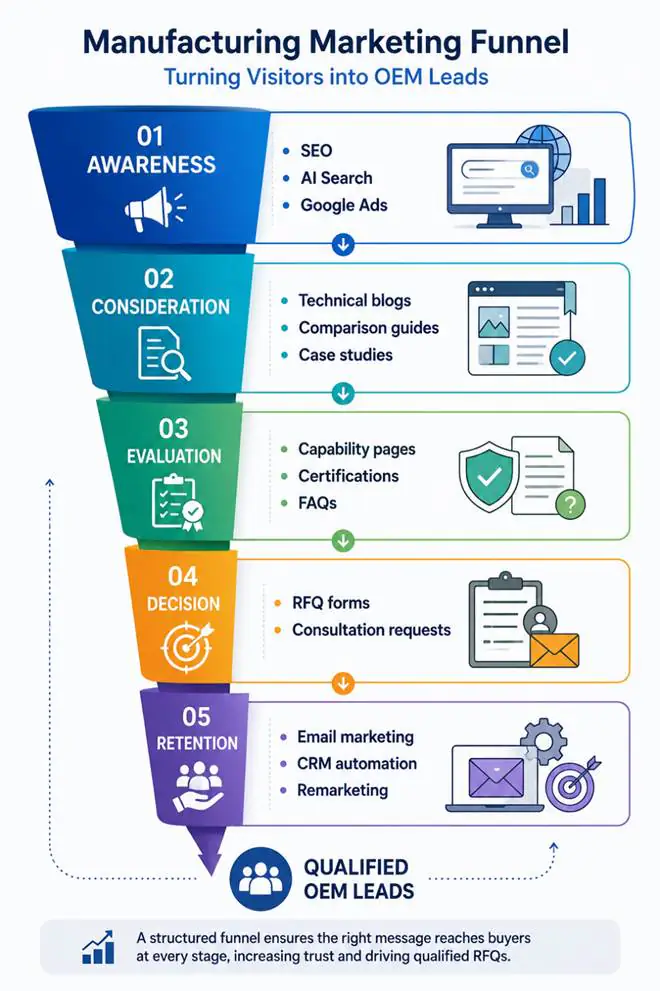
A structured marketing funnel ensures buyers receive the right information at the right time, increasing the likelihood of qualified RFQ submissions.
Why OEM Buyers Leave Manufacturing Websites Without Sending an RFQ
Even manufacturers with excellent production capabilities can lose opportunities because their websites fail to build confidence.
Some of the most common reasons include:
- Outdated website design
- Slow loading pages
- Missing product specifications
- No certifications displayed
- Difficult navigation
- Generic marketing language instead of technical information
- No downloadable catalogs or capability brochures
- Limited contact options
- Poor mobile experience
- Lack of customer success stories
Improving these areas helps establish credibility before the first conversation with a prospective customer.
Why Manufacturers Are Turning to Specialist Agencies in 2026
Running all four of these channels well, in-house, on top of running a manufacturing business, is a lot to ask of most internal teams. This is why more manufacturers are partnering with a dedicated manufacturing marketing agency rather than trying to piece it together themselves.
The difference between a generalist agency and a genuine B2B manufacturing marketing agency usually comes down to a few things:
- They understand technical sales cycles that stretch months, not days.
- They know how to translate engineering-heavy content into something that ranks and reads well to a non-technical buyer on the same account.
- They’ve built ABM and PPC programs specifically for manufacturers, not repurposed retail or SaaS playbooks.
- They treat the website as a lead-generation engine, not a digital business card.
Whether you search for digital marketing for manufacturers, an industrial digital marketing agency, or simply an industrial marketing company, the businesses generating the strongest OEM pipelines in 2026 are the ones treating digital visibility as seriously as they treat production quality.
A Practical Monthly Digital Marketing Plan for Manufacturers
Consistent marketing efforts often deliver better long-term results than occasional campaigns. A structured monthly plan helps maintain visibility and generate qualified enquiries over time.
| Week | Activity |
| Week 1 | Publish a technical blog targeting high-intent manufacturing keywords |
| Week 2 | Update service pages with new case studies, certifications, or FAQs |
| Week 3 | Review SEO performance, optimize pages, and monitor AI search visibility |
| Week 4 | Launch targeted Google Ads or LinkedIn campaigns and evaluate lead quality |
| Week 5 | Measure RFQs, keyword rankings, AI visibility, and campaign ROI |
Alongside these activities, regularly review website performance, respond to enquiries promptly, and update technical resources to reflect your latest manufacturing capabilities.
Conclusion:
Success in manufacturing marketing isn’t about using a single channel—it’s about creating a connected digital strategy. By combining Manufacturing SEO, AI Search Optimization (AEO), Google Ads, Account-Based Marketing (ABM), and a conversion-focused website, manufacturers can improve visibility, attract qualified OEM buyers, and generate consistent RFQs. As buyer research becomes increasingly digital and AI-driven, investing in a structured, data-driven marketing approach is essential for sustainable growth.
FAQs
Why should manufacturers invest in digital marketing in 2026?
Yes. Agencies specializing in niche industries like manufacturing and industrial B2B continue to grow because they understand technical buyers, long sales cycles, and industry-specific challenges better than generalist agencies.
How to generate leads in 2026?
Use a multi-channel strategy that combines SEO, AI Search Optimization (AEO), Google Ads, Account-Based Marketing (ABM), a conversion-focused website, and LinkedIn to engage buyers throughout their research journey.
How can manufacturers generate more OEM leads online?
Publish case studies, rank for niche industry keywords, stay active on LinkedIn, and build referrals and partnerships. Specializing in a specific industry typically generates better-quality leads than serving every market.
Is digital marketing still profitable in 2026?
Yes. Specialized services such as technical SEO, AI Search Optimization, ABM, and industry-focused strategies remain profitable because they deliver measurable results and higher-value leads.
Will AI replace digital marketers?
No. AI improves content creation, data analysis, and campaign optimization, but strategy, industry expertise, and understanding buyer behavior still require human expertise.
What is the 3-3-3 rule in marketing?
The 3-3-3 rule suggests spending 3 minutes finding a prospect, 3 minutes researching them, and 3 minutes creating personalized outreach, helping teams maintain consistent and efficient marketing efforts.