 +91 7550360374
  info@digitalbizstar.com
Why Manufacturing Websites Don’t Rank on Google (And How to Fix It in 2026)
Every day, engineers, procurement managers, and industrial buyers search Google for reliable manufacturing suppliers. If your website isn’t ranking, your competitors are winning those opportunities. In this guide, you’ll learn why manufacturing websites struggle to rank, how to identify the issues, and the practical steps to improve your Google visibility and generate more qualified RFQs.
How to Diagnose Why Your Manufacturing Website Isn’t Ranking
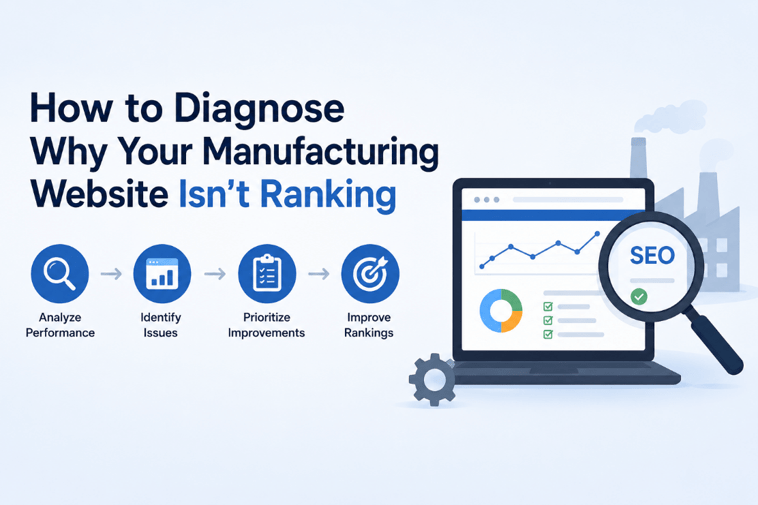
Before making changes to your website, identify the factors holding it back. Ask yourself these questions:
- Is my website indexed by Google?
- Which keywords am I currently ranking for?
- Are my product and service pages optimized for buyer intent?
- Does my website load quickly on desktop and mobile?
- Are there any crawl or indexing errors in Google Search Console?
- Am I publishing helpful content regularly?
- Do reputable manufacturing websites link to my website?
- Is my Google Business Profile optimized for local searches?
- Am I receiving organic traffic but very few enquiries?
You can use free tools like Google Search Console, Google Analytics 4, and Page Speed Insights to uncover many of these issues. A technical SEO audit will provide a more detailed view of your website’s health and highlight the improvements that will have the biggest impact.
How to Check if Google Has Indexed Your Website
Before fixing your rankings, it’s important to know whether Google has indexed your website. If your pages aren’t indexed, they won’t appear in search results regardless of how well they’re optimized.
Here are three simple ways to check:
Use Google’s Search Operator
Search Google using:
site:yourwebsite.com
Example:
site:digitalbizstar.com
If Google displays your pages, your website is indexed. If no pages appear, your website may have indexing issues.
Check Google Search Console
Open the Page Indexing report in Google Search Console to see:
- Indexed pages
- Excluded pages
- Crawl errors
- Pages blocked by robots.txt
- Noindex pages
Inspect Individual URLs
Use the URL Inspection Tool in Google Search Console to check whether a specific page has been indexed and request indexing if needed.
1. You’re Targeting the Wrong Keywords
One of the biggest mistakes manufacturers make is trying to rank for broad keywords like “industrial equipment” or “manufacturer.” These terms are highly competitive and often attract visitors who aren’t ready to buy.
Instead, focus on the specific phrases your ideal customers search for, such as:
- CNC machining services
- Sheet metal fabrication company
- Industrial pump manufacturer
- OEM component supplier
These keywords have stronger buying intent because they match what engineers, procurement managers, and industrial buyers are actively searching for.
2. Your Website Has Technical SEO Issues
Even the best content won’t rank if search engines can’t properly crawl and understand your website.
Website speed also affects user experience. According to Google, as page load time increases from 1 second to 3 seconds, the probability of a visitor leaving the page increases by 32%. Faster websites not only provide a better experience but also support stronger SEO performance.
Common technical problems include:
- Slow page speed
- Broken links
- Duplicate content
- Missing XML sitemap
- Crawl errors
- Poor website structure
Many manufacturing websites were built years ago and haven’t been updated to meet modern SEO standards.
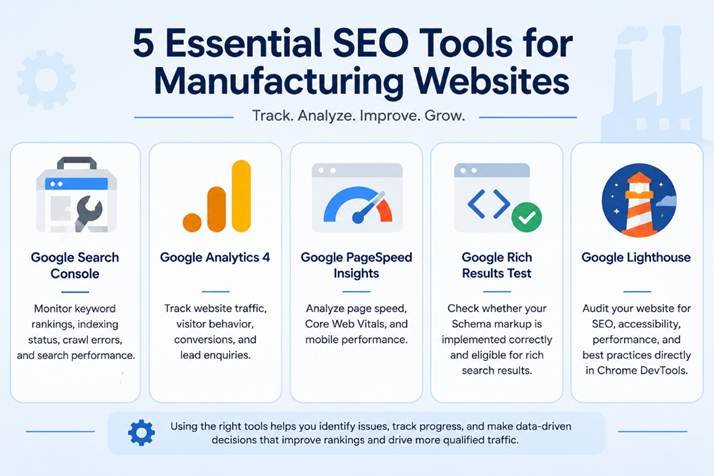
5 Free SEO Tools Every Manufacturer Should Use
You don’t need expensive software to understand your website’s SEO performance. These free tools provide valuable insights into technical issues, rankings, and user experience.
3. Your Product and Service Pages Don’t Provide Enough Information
Many manufacturing websites only include a short description for each product or service.
Today’s buyers expect detailed information before requesting a quote, and Google rewards pages that answer users’ questions thoroughly.
A strong product or service page should include:
- Product specifications
- Applications
- Industries served
- Certifications
- Frequently Asked Questions
- Technical resources
The more helpful your page is, the more likely it is to rank—and convert visitors into enquiries.
Real Examples of Poor vs. Optimized Product Pages
Not all product pages provide the information buyers—and search engines—need. Here’s a simple comparison:
| Poor Product Page | Optimized Product Page |
| Short 100-word description | Detailed product overview with technical specifications |
| No target keyword | Primary and secondary keywords naturally included |
| No product images | High-quality images with descriptive alt text |
| No FAQs | Frequently Asked Questions included |
| No internal links | Links to related products and services |
| No downloadable resources | CAD files, brochures, manuals, or datasheets available |
| Generic title | SEO-optimized title and meta description |
| No Schema markup | Product or Service Schema implemented |
Well-optimized product pages help Google understand your offerings while giving buyers the information they need to make informed decisions.
4. You’re Not Creating Helpful Content
Many manufacturers only update their website when launching a new product.
However, your potential customers spend time researching solutions before contacting suppliers. Educational content helps your business appear during this research phase.
Consider publishing blogs like:
- How CNC Machining Improves Precision
- Stainless Steel Grades Explained
- Industrial Valve Selection Guide
- Manufacturing SEO Guide
Helpful content builds trust, answers buyer questions, and positions your business as an industry expert.
5. You’re Missing Local SEO Opportunities
Even B2B manufacturers benefit from local SEO.
Many buyers search for suppliers using location-based searches such as:
- CNC machining company in Chicago
- Sheet metal fabrication near me
- Industrial supplier in Houston
If your business isn’t optimized for local searches, you’re missing valuable opportunities.
Improve your local visibility by:
- Optimizing your Google Business Profile
- Creating location-specific landing pages
- Building local business citations
- Encouraging customer reviews
6. Your Website Isn’t Mobile Friendly
Many engineers and purchasing managers research suppliers using their smartphones or tablets.
If your website loads slowly or is difficult to use on mobile devices, visitors may leave before contacting you.
A mobile-friendly website should include:
- Responsive design
- Fast loading pages
- Simple navigation
- Easy-to-find contact information
- Click-to-call buttons
A better mobile experience improves both rankings and conversions.
7. Your Website Lacks Authority
Google wants to recommend trustworthy businesses.
If your competitors have stronger backlinks and more industry recognition, they’ll often rank above you.
You can build authority by earning links from:
- Manufacturing directories
- Industry associations
- Trade publications
- Guest articles
- PR campaigns
- Trusted business websites
Quality backlinks tell Google that your business is credible and relevant.
Warning Signs Your Competitor Is Outranking You
Sometimes, the signs are obvious—other times, they’re easy to miss.
Your competitors may be outperforming you if:
- They appear above your website for important industry keywords.
- Their blogs answer common buyer questions while yours doesn’t.
- They publish content more consistently.
- Their product pages include more technical details.
- They have more customer reviews and stronger backlinks.
- Their website loads faster and offers a better user experience.
- They appear in Google’s AI-generated search results while your website doesn’t.
Regular competitor analysis helps identify gaps and opportunities to strengthen your SEO strategy.
8. Your Website Doesn’t Show Enough Trust Signals
Google looks for signs that your business is experienced and trustworthy.
Strengthen your credibility by showcasing:
- Company certifications
- Customer testimonials
- Case studies
- Team expertise
- Awards and recognitions
- Clear contact information
These trust signals not only help SEO but also encourage buyers to contact your business.
9. You’re Not Optimizing for AI Search
Search is changing quickly.
AI-powered search experiences are becoming more common, and businesses need content that answers questions clearly and accurately.
To prepare your website:
- Answer common customer questions
- Use structured data (Schema markup)
- Organize content with clear headings
- Publish detailed guides and resources
Optimizing for AI search helps your business stay visible as search continues to evolve.
10. You’re Not Measuring SEO Performance
You can’t improve what you don’t measure.
Many manufacturing companies invest in SEO but never track whether it’s generating results.
Monitor important metrics such as:
- Organic traffic
- Keyword rankings
- Google Search Console performance
- Google Analytics 4 reports
- Lead enquiries
- RFQ submissions
Regular monitoring helps you identify opportunities and improve your strategy over time.
How Digital BizStar Helps Manufacturing Companies Grow
At Digital BizStar, we help manufacturing and engineering companies improve their organic search performance through technical SEO, industry-focused keyword strategies, content optimization, and AI Search Optimization (AEO/GEO). Our approach focuses on improving crawlability, indexability, website architecture, Core Web Vitals, topical authority, and conversion-focused landing pages to attract qualified B2B buyers.
Whether you’re looking to increase organic visibility, improve keyword rankings, or generate more RFQs, we develop data-driven SEO strategies that deliver measurable, long-term growth.
Common Manufacturing SEO Mistakes to Avoid
Even companies that invest in SEO often make mistakes that limit their results. Watch out for these common issues:
- Targeting broad keywords instead of industry-specific search terms.
- Using the same content across multiple product pages.
- Publishing thin pages with little technical information.
- Ignoring technical SEO issues like slow loading speeds or broken links.
- Forgetting to optimize images, PDFs, and CAD files.
- Neglecting local SEO and Google Business Profile optimization.
- Failing to track keyword rankings and website performance.
- Expecting SEO results without consistent content updates.
Avoiding these mistakes can significantly improve your chances of ranking higher and attracting qualified B2B buyers.
A Quick Manufacturing Website SEO Checklist
Use this checklist to evaluate whether your website follows SEO best practices.
✅ Website is indexed by Google
✅ Product and service pages target relevant keywords
✅ Meta titles and descriptions are optimized
✅ Website loads in under 3 seconds
✅ Mobile-friendly design
✅ XML sitemap submitted
✅ HTTPS enabled
✅ Internal links between related pages
✅ Image alt text added
✅ Structured data (Schema) implemented
✅ Google Business Profile optimized
✅ Regular blog content published
✅ Google Search Console monitored
If you answered “No” to several of these, your website likely has opportunities to improve its search visibility.
Final Thoughts
If your manufacturing website isn’t ranking on Google, don’t assume it’s because your industry has low search demand. In most cases, the real issues are poor keyword targeting, technical SEO problems, thin content, weak authority, or a lack of ongoing optimization.
By improving these areas, you can increase your search visibility, attract more qualified B2B buyers, and generate consistent enquiries from companies actively looking for your products and services.
SEO is a long-term investment, but with the right strategy, it becomes one of the most reliable ways to grow your manufacturing business online.
Frequently Asked Questions
Why is my manufacturing website not appearing on Google?
Your website may not appear on Google because it isn’t indexed, targets the wrong keywords, has technical SEO issues, or lacks high-quality content and backlinks. Checking Google Search Console is the best place to start diagnosing the problem.
How can I check if my manufacturing website is indexed by Google?
You can search site:yourwebsite.com in Google to see indexed pages. For more detailed information, use Google Search Console’s Page Indexing report and URL Inspection Tool.
What are the biggest SEO mistakes manufacturing companies make?
Common mistakes include targeting generic keywords, publishing thin product pages, ignoring technical SEO, neglecting local SEO, and failing to update website content regularly.
Why are my competitors ranking higher than my website?
Competitors may have stronger technical SEO, more detailed content, better keyword targeting, higher-quality backlinks, and greater website authority. Regular competitor analysis helps identify opportunities to improve your rankings.
Does technical SEO really matter for manufacturing websites?
Yes. Technical SEO ensures search engines can crawl, index, and understand your website. Factors like page speed, mobile usability, site structure, and Core Web Vitals directly impact search visibility.
How often should manufacturing websites publish new content?
Publishing one or two high-quality articles each month helps keep your website relevant. Updating existing product pages, technical resources, and case studies also improves long-term SEO performance.
Can product pages rank on Google without blog content?
Yes, well-optimized product and service pages can rank independently. However, publishing educational blog content helps build topical authority, target additional keywords, and attract buyers earlier in their research process.