 +91 7550360374
  info@digitalbizstar.com
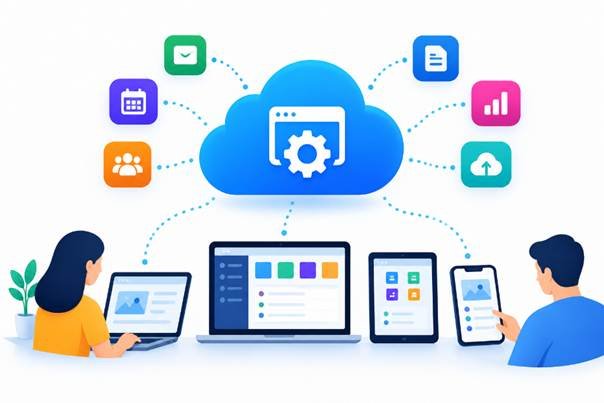
SaaS (Software as a Service) is a way of using software online without installing or maintaining it yourself. You simply access it through a browser or app, while the provider manages updates, servers, and maintenance.
For example, Gmail is a SaaS product. You don’t install email software on your computer or manage the servers. You simply log in through your browser, and Google manages the software, storage, security, and updates.
What Does SaaS Mean?
SaaS stands for Software as a Service.
It is a software delivery model where applications are hosted by a provider and accessed over the internet, usually through a web browser or mobile/desktop app.
Instead of installing and running the software entirely on your own computer or company servers, you access the software as an ongoing service.
Most SaaS products use a recurring subscription model, where customers pay monthly or annually to continue using the software.
A Simple Example
Think about the difference between buying a car and using a ride-sharing service.
When you buy a car, you own it and are responsible for:
- Maintenance
- Repairs
- Insurance
- Storage
- Upgrades
With a ride-sharing service, you simply pay when you need a ride while someone else manages the vehicle.
SaaS works in a similar way. Instead of purchasing and maintaining the software infrastructure yourself, you pay to use software that the provider hosts, maintains, updates, and manages.
How Does SaaS Work?
SaaS is built on cloud computing. The software runs on infrastructure managed by the SaaS provider, and customers access it over the internet.
Here’s what typically happens behind the scenes:
1. The provider hosts the software
The SaaS company builds and hosts its application on cloud infrastructure. Common cloud platforms include Amazon Web Services (AWS), Google Cloud, and Microsoft Azure.
2. Multiple customers use the application
Many SaaS applications use a multi-tenant architecture, where a single application serves multiple customers.
Although customers may share the underlying application and infrastructure, their data and access are logically separated and protected.
3. Users access the software online
Customers typically access the application through a web browser or an app. They don’t need to install the entire software system on their own servers.
4. The provider manages maintenance
The SaaS provider is generally responsible for:
- Software updates
- Security patches
- Bug fixes
- Infrastructure
- Performance
- Server availability
Updates can usually be delivered centrally without requiring every customer to manually install a new version.
5. Customers pay for access
Customers typically pay a recurring fee based on factors such as:
- Number of users
- Features
- Usage
- Subscription tier
- Contract size
Billing may be monthly or annually, depending on the provider.
SaaS Customer Journey
A typical SaaS journey moves from problem → search → comparison → trial/demo → purchase → retention. Buyers may use Google, AI search, reviews, and comparison pages before deciding which software to use. This is why SaaS companies need content that supports customers at every stage of the buying journey.
SaaS vs Traditional On-Premise Software
This is different from traditional on-premise software.
With on-premise software, a company may need to:
- Purchase a software license
- Install the software on its own systems
- Maintain servers or computers
- Install updates
- Manage security
- Handle infrastructure and technical maintenance
With SaaS, much of this responsibility is handled by the software provider.
Key Characteristics of SaaS
Although SaaS products can work differently from one another, most share several common characteristics.
Important SaaS Metrics
SaaS companies commonly track MRR, ARR, CAC, LTV, churn rate, and conversion rate to measure recurring revenue, customer acquisition, retention, and overall growth.
Subscription-based pricing
Customers generally pay a recurring fee rather than making a large one-time software purchase.
Cloud-hosted
The application is hosted on cloud infrastructure managed by the provider rather than requiring customers to host the entire application themselves.
Accessible from anywhere
Users can generally access the software from different locations and devices as long as they have an internet connection and the appropriate access.
Automatic updates
The provider manages software updates, bug fixes, and new releases, reducing the need for customers to manually update the application.
Multi-tenant architecture
Many SaaS platforms use a shared application architecture where multiple customers use the same core software while keeping customer data and access separated.
Scalable
SaaS products can make it easier for businesses to add users, upgrade plans, or adjust their usage as their requirements change.
SaaS vs PaaS vs IaaS
SaaS is one of the three major cloud service models. The other two are PaaS (Platform as a Service) and IaaS (Infrastructure as a Service).
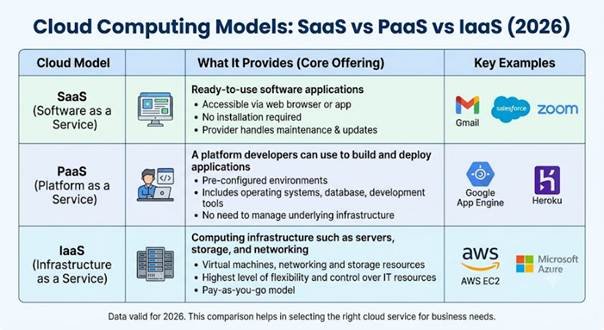
A simple way to remember the difference:
IaaS gives you the building blocks.
PaaS gives you the workshop.
SaaS gives you the finished product, ready to use.
Real-World Examples of SaaS
SaaS is used across almost every area of business and personal software.
Here are some common examples:
- Communication: Slack, Zoom, Microsoft Teams
- CRM & Sales: Salesforce, HubSpot
- Project Management: Asana, Monday.com, Trello
- Design: Canva, Figma
- Finance & Accounting: QuickBooks Online, Xero
- Marketing: Mailchimp, Semrush
- Entertainment: Netflix, Spotify
For example, a sales team may use Salesforce to manage customer relationships, a marketing team may use Semrush for search marketing research, and a design team may use Figma to collaborate on designs.
The important point is that SaaS isn’t limited to one industry or type of software. It can support everything from communication and accounting to marketing, design, sales, and entertainment.
Why Do Businesses Choose SaaS?
Businesses choose SaaS for several practical reasons.
1. Lower upfront costs
Traditional software may require large upfront investments in licenses, hardware, and infrastructure.
SaaS generally uses subscription pricing, which can make it easier for businesses to start using software without a large initial investment.
2. Faster time to value
SaaS applications can often be set up much faster than traditional on-premise software.
Instead of going through a lengthy installation and infrastructure setup process, users can often create an account, configure the application, and start working within minutes.
3. Automatic updates and maintenance
The SaaS provider manages software updates, bug fixes, security patches, and new features.
Customers don’t usually need to manually install every update, which reduces the technical workload for internal teams.
4. Accessibility
SaaS makes it easier for teams to access software from different locations.
Employees may be able to work from:
- Home
- The office
- A client location
- Another city or country
Access generally requires an internet connection and appropriate account permissions.
5. Scalability
Businesses can often add users, change plans, or increase usage as they grow.
For example, a company with 10 employees may start with a smaller subscription and increase the number of users as its team expands.
6. Predictable costs
Recurring subscription pricing can make software costs easier to forecast and budget for.
Instead of dealing with large software upgrades, hardware purchases, and maintenance costs, businesses can plan around their recurring SaaS expenses.
Common SaaS Pricing Models
SaaS companies use different pricing models depending on their product and customers.
Flat-rate pricing
The customer pays one fixed price for access to the product, regardless of the number of users or amount of usage.
Per-user or per-seat pricing
The price depends on how many users have access to the software.
For example, a company may pay a certain amount for each employee using the platform.
Tiered pricing
The provider offers several plans with different features and prices.
A common structure might include:
- Basic
- Professional
- Business
- Enterprise
Customers choose the plan that best fits their requirements.
Usage-based pricing
Customers pay according to how much they actually use the service.
Depending on the product, pricing could be based on metrics such as:
- Number of emails sent
- API calls
- Storage
- Transactions
- Data processed
Freemium
The provider offers a free version with limited features and allows customers to upgrade to a paid plan when they need additional functionality.
Freemium is commonly used to attract users before converting some of them into paying customers.
Challenges and Considerations With SaaS
SaaS offers many benefits, but it also has some trade-offs that businesses should consider.
Ongoing costs
A subscription may appear inexpensive at first, but monthly or annual payments can add up over several years.
Businesses should evaluate the long-term cost rather than looking only at the initial subscription price.
Internet dependency
Most SaaS applications rely on an internet connection.
If the connection is unreliable or the service experiences an outage, users may have difficulty accessing the application.
Data security and compliance
Businesses need to understand how a SaaS provider protects customer data.
This becomes particularly important when the software handles sensitive business, financial, customer, or regulated information.
Companies should consider factors such as:
- Security controls
- Data protection
- Access management
- Backup practices
- Compliance requirements
- Data storage and processing policies
Vendor lock-in
Moving from one SaaS platform to another isn’t always simple.
Businesses may need to migrate data, rebuild integrations, retrain employees, and adjust internal processes.
Before choosing a SaaS provider, it’s useful to understand how easily data can be exported and how the platform integrates with other systems.
Less customization
SaaS products are usually designed to serve a broad customer base.
Although many offer configuration options, they may not provide the same level of customization as a completely custom-built, on-premise application.
The Future of SaaS
SaaS continues to evolve as technology, customer expectations, and business needs change.
Several trends are shaping the future of SaaS.
AI-embedded SaaS
AI is increasingly being built directly into SaaS products.
Examples include:
- AI assistants
- Automated workflows
- Predictive analytics
- Content generation
- Intelligent recommendations
- Data analysis
Rather than being a separate tool, AI is becoming part of the software experience itself.
Vertical SaaS
Instead of creating software for everyone, vertical SaaS companies build products for specific industries or niches.
Examples could include software designed specifically for:
- Construction
- Healthcare
- Logistics
- Manufacturing
- Financial services
These platforms can address industry-specific workflows and requirements more closely than general-purpose software.
Product-led growth
More SaaS companies are allowing potential customers to experience the product before speaking with a salesperson.
Common approaches include:
- Free trials
- Freemium plans
- Product demos
- Self-service sign-up
This approach allows users to evaluate the product themselves before making a purchasing decision.
API-first and integration-heavy products
Businesses rarely use just one software platform.
Modern SaaS products increasingly need to connect with other tools through APIs and integrations.
For example, a CRM may need to connect with:
- Marketing automation
- Accounting software
- Customer support platforms
- Analytics tools
- Communication platforms
As businesses rely on larger technology stacks, seamless integration becomes increasingly important.
FAQs
Is SaaS the same as cloud computing?
No.
Cloud computing is the broader concept of delivering computing resources and services over the internet.
SaaS is one specific cloud service model. The other major models are PaaS and IaaS.
In simple terms, cloud computing is the larger category, while SaaS is one way cloud technology is delivered to users.
What’s an example of SaaS in everyday life?
Gmail, Netflix, and Spotify are familiar examples of cloud-based services commonly described as SaaS or SaaS-like consumer services.
You access the service through a browser or app, while the provider manages the underlying software and infrastructure.
Is SaaS only for large businesses?
No.
SaaS is used by businesses of all sizes, including:
- Startups
- Small businesses
- Medium-sized companies
- Large enterprises
- Solo entrepreneurs
One reason SaaS is popular with smaller businesses is that it can reduce the need for large upfront investments in software and infrastructure.
How is SaaS different from a mobile app?
A mobile app can be SaaS, but not every mobile app is SaaS.
For example, an application such as Spotify uses cloud-hosted services and can be accessed through a subscription.
However, some mobile apps may be purchased once or operate entirely offline without being delivered as an ongoing cloud software service.
The important distinction is how the software is delivered and operated, not simply whether it runs on a phone.
Final Thoughts
SaaS has transformed the way businesses use software by providing flexibility, scalability, faster deployment, and easier access. As AI and cloud technologies continue to evolve, SaaS will remain an important part of modern business.
For SaaS companies, combining a strong product with SEO, AI Search Optimization, content marketing, and paid advertising can help attract the right audience and drive sustainable growth.
Ready to grow your SaaS business? Connect with Digital BizStar and turn your online visibility into qualified opportunities.
Talk to Digital BizStar
https://digitalbizstar.com/contact-us/