
 +91 7550360374
 info@digitalbizstar.com


How do I learn SEO as a beginner?
Start with how search engines work, then practise on one real website. Reading alone won’t teach you much. Changing a title and checking Search Console two weeks later will.
You need three things to begin: a website you can edit, a free Google Search Console account and about two hours a week. Everything below assumes only that.
SEO basics: how search engines work
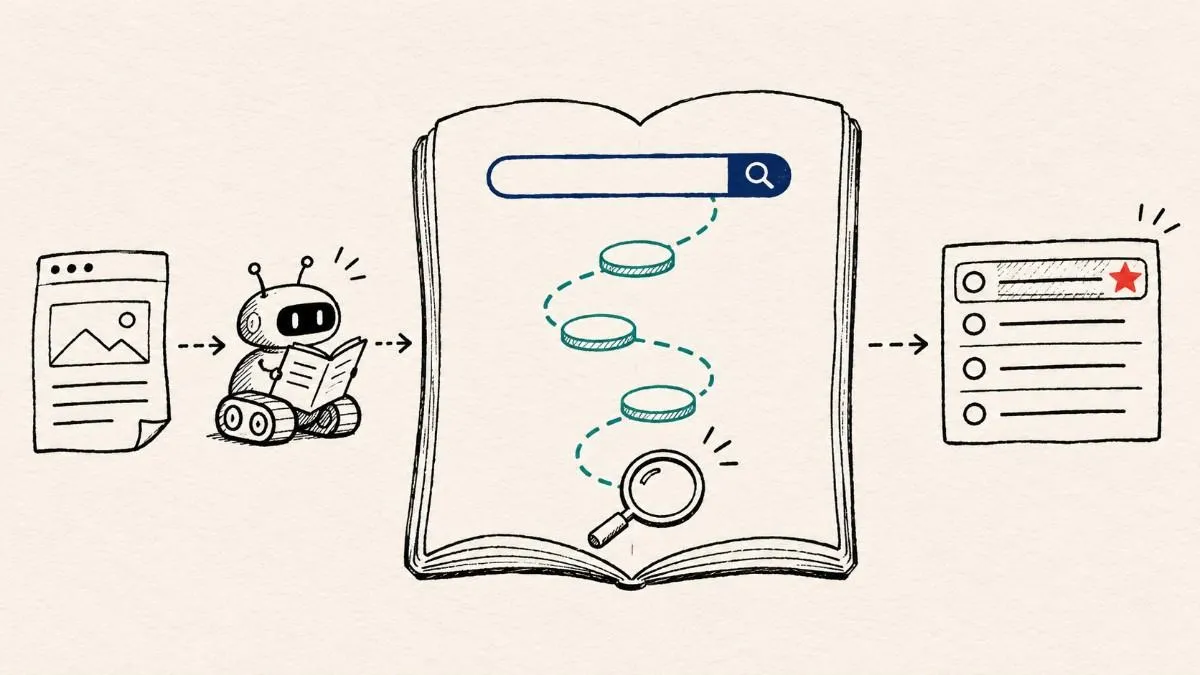
Google does three jobs.
- Crawling. Its bots follow links to discover pages.
- Indexing. It stores and organises what it found.
- Ranking. For each search, it picks the pages that best answer the question and orders them.
Your job is to make each step easy. Pages must be easy to reach and clearly about something people search for. That’s the whole game. The rest is detail. For a fuller definition, read what SEO is and how it works.
Step 1: Make sure Google can find your site
If you’ve ever searched “how to do SEO”, this is the order we recommend, because each step depends on the one before.
Before writing a word, check the basics. If your site is live but still hard to find, see why a website is not ranking on Google.
- Add your site to Google Search Console and verify it.
- Submit your XML sitemap. On WordPress, plugins such as Yoast or Rank Math create one for you.
- Use the URL Inspection tool on your homepage. It tells you whether Google has indexed it.
- Check that no important page carries a “noindex” tag by mistake. This happens more often than you’d think after a website redesign.
If a page isn’t indexed, it can’t rank. Fix this first.
Step 2: Choose keywords people actually type
A keyword is the phrase someone types or speaks. Beginners often pick words they like rather than words customers use.
Write down 20 ways a customer might describe what you sell, including your city. A Chennai dental clinic might list “dentist in Anna Nagar”, “root canal cost Chennai” and “kids dentist near me”. Then check them:
- Intent. Does the searcher want to learn or to buy? Match your page to that.
- Demand. Google’s Keyword Planner shows rough monthly searches for free. Search Console shows the real queries already bringing you impressions.
- Difficulty. Broad phrases like “SEO” are dominated by big sites. Phrases with a city or a specific problem are far easier for a small business.
Give each important page one main phrase. Don’t make one page chase ten topics.
Searching in Tamil, Hindi and other Indian languages
Many Indian customers search in their own language or mix it with English, such as “best hospital Madurai la”. If your customers do this, consider a page in that language, written by a fluent speaker. Machine translation reads badly and rarely ranks.
Step 3: Write pages that answer the question
Google’s own SEO Starter Guide keeps returning to one idea: make content that is helpful and written for people. In practice:
- Put the direct answer in the first two or three sentences.
- Use headings that match the questions people ask.
- Add the details a customer needs to decide, such as prices, timings, areas served or steps.
- Show who wrote it and when it was last updated.
How long should a page be? There’s no magic number. Google’s Search Liaison, Danny Sullivan, said in June 2023 that the best word count “doesn’t exist”. Look at the pages already ranking for your keyword and cover the topic at least as well.
Step 4: Fix the on-page basics
These take minutes per page and help every time.
| Element | What good looks like | Common beginner mistake |
|---|---|---|
| Title tag | 50 to 60 characters, main phrase near the start | “Home” or the company name only |
| Meta description | About 150 characters saying what the page offers | Left blank, so Google picks random text |
| H1 heading | One per page, matching the topic | Several H1s, or none |
| URL | Short and readable, e.g. /root-canal-cost/ | /page?id=1234 |
| Image alt text | Describes the image in a few words | Left empty or stuffed with keywords |
| Internal links | Link related pages using descriptive words | “Click here” links |
Step 5: Keep the site fast and mobile-friendly
Most Indian searches happen on phones, often mid-range Android phones on patchy connections. Open your site on one. If it takes more than a few seconds to show anything, visitors leave.
Run your main pages through PageSpeed Insights, which is free. Large images are the usual culprit. Compress them, and use a lightweight theme if your site feels slow.
Also make sure every page uses HTTPS. Most hosts provide a free certificate.
Step 6: Set up local SEO if you serve a city
If customers visit you or you serve a nearby area, your Google Business Profile matters as much as your website. Google says local results are based mainly on relevance, distance and prominence (Google Business Profile Help).
- Claim your profile and pick accurate categories.
- Add opening hours and the services you offer, with real photos.
- Keep your business name, address and phone number identical everywhere online.
- Ask happy customers for reviews, and reply to every review, good or bad.
- List your business in directories you genuinely belong to, such as your trade association.
Never use an address where you don’t operate. It can get your profile suspended.
Step 7: Earn links and mentions honestly
When other trusted websites link to you or mention your brand, Google and AI tools treat that as a vote of confidence. Good starting points cost nothing: suppliers and partners who can list you, local news when you do something newsworthy, industry associations and genuinely useful posts on LinkedIn.
Avoid anyone selling “1,000 backlinks for ₹999”. Paid link schemes break Google’s spam policies and can sink a site.
Step 8: Measure with free tools
Check Search Console once a month. Look at:
- Queries bringing impressions, which shows how Google sees your pages.
- Pages with many impressions but few clicks. A better title and description often fixes these quickly.
- Pages losing clicks compared with the previous period.
Google Analytics 4 shows what visitors do after they arrive, such as whether they fill your enquiry form.
SEO and AI search: what beginners should know
People now ask ChatGPT or Google’s AI Overviews for recommendations. These tools read web pages to build their answers. You can’t buy your way into them, but the same habits that help SEO also help here:
- A clear answer near the top of each page.
- Facts with sources and dates.
- A named author and an honest update date.
- Your brand mentioned on other sites, not just your own.
Our guide to AI search optimization goes deeper, and AEO vs SEO vs GEO explains how the three differ. To check what AI tools say about you, compare AEO checking software.
A 30-day starter plan
| Days | Task | Time needed |
|---|---|---|
| 1 to 3 | Set up Search Console and Analytics; submit sitemap | 2 hours |
| 4 to 7 | List 20 customer phrases; map one to each key page | 2 hours |
| 8 to 14 | Rewrite titles, descriptions and H1s on your top five pages | 3 hours |
| 15 to 21 | Add a short question-and-answer section to those pages | 3 hours |
| 22 to 26 | Claim or fix Google Business Profile; request five reviews | 2 hours |
| 27 to 30 | Check Search Console; note changes; pick the next five pages | 1 hour |
Common beginner mistakes
- Chasing one broad keyword instead of many specific ones.
- Copying competitor text. Google has no reason to prefer a copy.
- Making many thin pages that only swap the city name.
- Expecting results in a week. New pages usually take months.
- Trusting anyone who promises a guaranteed first position. Google itself says “No one can guarantee a #1 ranking on Google” (Google Search Central).
When to get help
You can do the basics yourself. Bring in help when your competitors are strong, when your site has technical problems you can’t diagnose, or when you simply don’t have the time. Digital BizStar is a digital marketing agency in Chennai that does SEO for small and mid-size businesses across India. If you’re comparing costs first, see our SEO packages in India guide. Based in southern Tamil Nadu? See our list of top digital marketing and SEO companies in Madurai.
SEO for beginners: FAQs
Can I learn SEO by myself?
Yes. Free resources like Google’s SEO Starter Guide and your own Search Console data are enough to learn the basics. Practice on a real site matters more than courses.
Is SEO paid or free?
Appearing in Google’s organic results is free. You pay in time, or for tools and experts if you hire help. Paid ads are a separate thing.
Can I learn SEO in 7 days?
You can learn the core ideas in a week. Getting good takes months of practice, because results take weeks to show.
How do I do SEO for my own website?
Follow the steps above in order: get indexed, pick keywords, write helpful pages, fix titles and speed, set up local SEO and earn honest links. Then measure monthly.
How long does SEO take to work?
Small changes can show in a few weeks. Steady results usually take three to six months, depending on competition.
Is SEO dead because of AI?
No. AI tools still read and quote web pages. Clear, trustworthy pages are what they draw on.