 +91 7550360374
  info@digitalbizstar.com
SEO for Manufacturing Companies
Manufacturing buyers no longer rely only on trade shows and referrals. Today, engineers, procurement managers, and industrial buyers begin their supplier search on Google. If your company isn’t visible in search results, you’re losing valuable RFQs and business opportunities. This guide explains how manufacturing SEO works, why it matters in 2026, and the steps you can take to improve rankings, generate qualified leads, and grow your business.
Quick Summary
In this guide you’ll learn
- What Manufacturing SEO is
- Why it matters
- Keyword research
- Technical SEO
- Product page optimization
- AI Search Optimization
- Local SEO
- International SEO
- SEO checklist
If you want a structured strategy tailored to your business, our Manufacturing SEO Services help improve search visibility, attract qualified B2B buyers, and generate more RFQs.
Table of Contents
| No. | Table of Contents |
| 1 | What is Manufacturing SEO? |
| 2 | Why Manufacturing SEO Matters |
| 3 | How Manufacturing SEO is Different |
| 4 | Keyword Research for Manufacturers |
| 5 | Technical SEO for Manufacturing Websites |
| 6 | Product & Service Page Optimization |
| 7 | Industrial Content Marketing |
| 8 | Local SEO for Manufacturers |
| 9 | International SEO for Exporters |
| 10 | AI Search Optimization for Manufacturers |
| 11 | Common Manufacturing SEO Mistakes |
| 12 | Manufacturing SEO Checklist |
| 13 | Frequently Asked Questions (FAQs) |
| 14 | Why Choose Digital BizStar? |
1. What is SEO for Manufacturing Companies?
SEO for manufacturing companies is the practice of optimizing a manufacturer’s website, content, and technical infrastructure so that it ranks higher in search engines for the terms that engineers, procurement teams, distributors, and executives actually use when researching suppliers, parts, and industrial solutions.
At its core, manufacturing SEO covers the same three pillars as any other SEO discipline:
- On-page SEO — optimizing product pages, service pages, titles, headers, and content so search engines (and buyers) understand exactly what you make and who it’s for.
- Technical SEO — making sure a site with hundreds or thousands of SKUs, spec sheets, and CAD files can actually be crawled, indexed, and loaded quickly.
- Off-page SEO — earning backlinks, citations, and mentions from distributors, trade publications, and industry directories that build authority.
The difference is context. Manufacturing SEO isn’t about ranking for broad, high-volume consumer terms — it’s about being found by a much smaller, far more qualified audience of technical buyers who search using part numbers, specifications, certifications, and industry-specific language. Done right, it becomes the digital equivalent of your best sales rep: available 24/7, answering technical questions, and pre-qualifying leads before they ever reach your sales team.
📌 Key Takeaways
✅ Manufacturing SEO helps your business attract highly qualified B2B buyers.
✅ It combines On-page SEO, Technical SEO, and Off-page SEO.
✅ Focus on industry-specific keywords rather than broad consumer terms.
✅ A well-optimized website supports lead generation 24/7.
2. Why Manufacturers Need SEO in 2026
Industrial buying has quietly gone digital. A growing share of B2B purchasing interactions between suppliers and buyers now happen through digital channels rather than in person, and the typical buyer moves across numerous touchpoints — websites, spec sheets, review sites, and search — before ever contacting a sales rep.
For many manufacturers, organic search now drives a large share of overall site traffic, and a majority of sales-qualified leads can trace back to organic discovery.
A few forces are accelerating this shift heading into 2026:
- Procurement teams do their own research. Most B2B buyers already have a shortlist of vendors in mind before sales ever gets involved, built almost entirely from what they find online.
- AI-powered and answer-engine search is changing discovery. Buyers increasingly ask AI tools and chat-based search engines for supplier recommendations, meaning your content needs to be structured for both traditional rankings and AI-generated answers. As AI-powered search continues to evolve, manufacturers should also optimize for answer engines. Learn more about our AI Search Optimization (AEO/GEO) services.
- Trade shows and cold outreach cost more, deliver less. SEO offers a compounding, lower-cost-per-lead alternative that keeps working long after a single event ends.
- Competitors are already investing. Manufacturing SEO agencies report client campaigns generating double-digit growth in organic revenue year over year — meaning the manufacturers who wait are ceding ground to those who don’t.
If your ideal buyer is searching for a solution and your competitor’s product page shows up instead of yours, you never even get considered.
📊 Did You Know?
Most B2B buyers research suppliers online before contacting a sales representative. A strong online presence helps manufacturers get discovered early in the buying process.
📌 Key Takeaways
✅ Manufacturing buyers research suppliers online before contacting sales.
✅ AI-powered search is changing how buyers discover manufacturers.
✅ SEO generates long-term visibility and qualified RFQs.
✅ Businesses investing in SEO today gain a competitive advantage.
3. How Manufacturing SEO Differs from Traditional SEO
Manufacturing SEO is a distinct discipline from traditional B2C or general B2B SEO because industrial buyers have unique search behavior, longer buying cycles, and highly technical purchasing requirements. Unlike consumer SEO, success in manufacturing is measured by qualified RFQs, engineering enquiries, and long-term customer relationships rather than just website traffic.
Traditional SEO vs Manufacturing SEO
Manufacturing SEO differs significantly from traditional SEO because industrial buyers have longer buying cycles, technical requirements, and multiple decision-makers. The comparison below highlights the key differences.
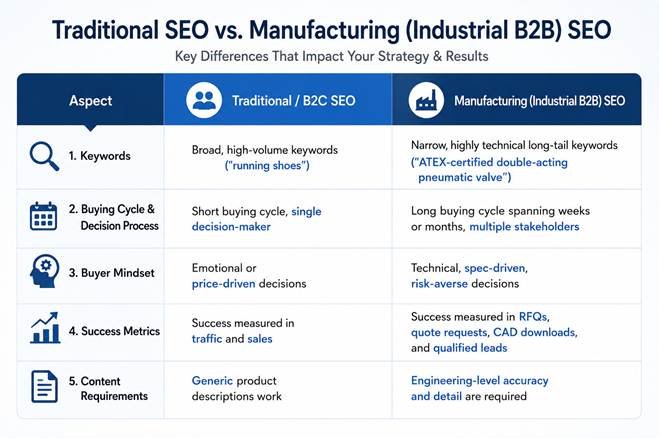
Because manufacturing buyers include engineers evaluating specifications, plant managers assessing capabilities, and finance or executive stakeholders focused on ROI, a single product page often needs to satisfy several very different reading levels and intents at once.
That’s why generic, templated product copy — the kind many distributors simply copy-paste from a manufacturer’s data sheet — consistently underperforms in industrial search results and can even be flagged as duplicate content.
4. Keyword Research for Manufacturers
Keyword research is the foundation of every manufacturing SEO strategy, and it starts by mapping the language of your actual buyers, not marketers.
Go beyond generic terms. A phrase like “industrial pumps” is broad, saturated, and rarely tied to real buying intent. A phrase like “stainless steel 316L pump distributor Chicago” or “5-axis CNC machining for aerospace aluminum” signals a buyer who already knows what they need and is close to requesting a quote.
Segment by buyer experience level. A veteran plant manager searches in industry shorthand (“ASME B31.3 piping requirements”), while a newer engineer searches more descriptively (“how to read ASME piping codes”). Both matter — but they need different content.
Where to find real keyword data:
- Your sales team. They already know the exact phrases prospects use on every call.
- Customer support tickets and RFQ forms. These reveal the problems people are actually trying to solve.
- “People Also Ask” and related-search results on Google for your core services.
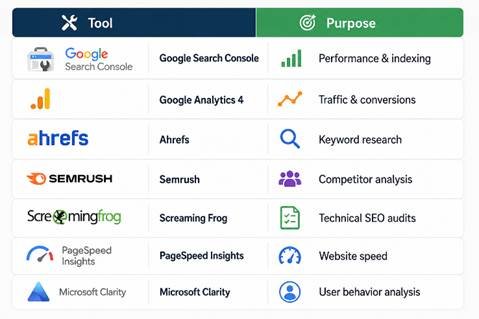
- Keyword tools such as Ahrefs, Semrush, or Google Keyword Planner, used to check search volume against commercial intent — a lower-volume keyword with obvious buying intent is usually worth more than a high-volume, vague one.
Organize by funnel stage. Group keywords into problem/awareness (“why is my hydraulic pump making noise”), solution/consideration (“how to choose a custom metal fabricator”), and decision (“[your company] case studies,” “[your company] vs [competitor]”) so every stage of the buyer journey has content to match.
📈 Did You Know?
Long-tail keywords often attract more qualified B2B leads because they reflect specific products, applications, or technical requirements.
📌 Key Takeaways
✅ Focus on long-tail, high-intent keywords.
✅ Use customer questions and RFQs to discover keyword opportunities.
✅ Group keywords based on the buyer journey.
✅ Prioritize commercial intent over search volume.
5. Technical SEO for Manufacturing Websites
Manufacturing websites tend to have unique technical challenges: massive product catalogs, heavy spec sheets and CAD files, multiple regional or dealer sites, and legacy CMS platforms. Getting the technical foundation wrong means Google can’t properly crawl, index, or rank your pages — no matter how good your content is.
Priorities to focus on:
- Fix duplicate content. Distributors and manufacturers frequently reuse the same manufacturer-supplied product descriptions across dozens or hundreds of pages. Search engines treat this as low-value or spam content. Rewrite descriptions with unique details — applications, industries served, compatible materials, maintenance notes — and use canonical tags for legitimate product variations.
- Improve site speed. Manufacturing sites are often slowed down by high-resolution product images, PDF catalogs, and product configurators. Compress and convert images to WebP, implement lazy loading, use a CDN, and minify code. Site speed directly affects both rankings and conversions — slow-loading pages lose visitors before they ever see your offer.
- Fix crawlability and site architecture. A clear, logical URL structure and internal linking hierarchy help search engines (and buyers) navigate a catalog with hundreds or thousands of SKUs.
- Add schema markup. Product, FAQ, local business, and review schema help search engines understand your pages and can unlock rich snippets — enhanced listings with pricing, availability, or star ratings that improve click-through rates.
Technical SEO works best when combined with performance tracking. Our Analytics & Growth Reporting helps you measure SEO performance and business results.
- Go mobile-first. With Google using mobile-first indexing, a manufacturing site that isn’t fully responsive is fighting an uphill battle regardless of content quality.
- Audit regularly. Tools like Screaming Frog and Google PageSpeed Insights should be run on a recurring basis to catch broken links, crawl errors, and speed regressions before they hurt rankings.
⚡ Did You Know?
A slow-loading website can reduce conversions and increase bounce rates. Improving page speed enhances both user experience and search performance.
📌 Key Takeaways
✅ Improve website speed and Core Web Vitals.
✅ Eliminate duplicate content.
✅ Implement Product, FAQ, and Organization schema.
✅ Ensure your website is mobile-friendly.
✅ Perform regular technical SEO audits.
Essential Manufacturing SEO Tools and Their Purpose
6. Product & Service Page Optimization
Your product and service pages are where SEO traffic turns into RFQs — so they need to do more than list specs.
Write unique, benefit-driven descriptions. Instead of a generic line like “the XYZ-500 pump delivers reliable performance,” specify flow rate, pressure rating, compatible materials, and the industries or applications it serves best. This satisfies both search engines and the engineers evaluating your product.
Include structured technical data. Downloadable spec sheets, tolerance tables, and certification details (ISO, ASME, ATEX, FDA, etc.) build trust and answer buyer questions before they ever contact sales.
Add FAQ sections with schema markup. Technical FAQs addressing the most common buyer questions can win featured snippets and rich results in search.
Use demo and explainer videos. Short videos that show a product or process in action help buyers understand complex items faster — and video content tends to perform well with technical B2B audiences.
Optimize metadata on every page. Clear, keyword-rich title tags, meta descriptions, and URL structures should reflect exactly what a page offers, without keyword stuffing.
A high-performing website improves both rankings and conversions. Explore our Website Design & Conversion Optimization services to create SEO-friendly manufacturing websites.
📄 Did You Know?
Manufacturing buyers often review technical specifications, certifications, and downloadable resources before requesting a quote. Well-optimized product pages help answer these questions and build trust.
📌 Key Takeaways
✅ Write unique, detailed product descriptions.
✅ Include technical specifications and certifications.
✅ Add FAQs and schema markup.
✅ Optimize page titles, meta descriptions, and URLs.
7. Industrial Content Marketing
Content marketing is how manufacturers earn trust long before a prospect ever fills out a form. Most B2B buyers have already narrowed down their shortlist of vendors before formal outreach even begins, which means your content is doing the selling while your sales team isn’t even in the room yet.
Structure content around the buyer journey:
- Awareness stage: Problem-diagnosis blog posts and educational guides (“5 warning signs your hydraulic system is about to fail,” “understanding tolerance stack-up in precision manufacturing”).
- Consideration stage: Comparison guides, buying guides, and technical deep-dives (“CNC machining vs. 3D printing for prototyping,” “how to evaluate a CNC machine shop”).
- Decision stage: Case studies with real, specific numbers, technical specification pages, and reviews or testimonials that give a nearly-convinced buyer the final confirmation they need.
Repurpose everything. A single case study can become a blog post, a slide deck, a LinkedIn post, and a sales one-pager, multiplying its SEO and sales value.
Build linkable assets. Interactive tools — ROI calculators, material selection wizards, pump sizing calculators, lead time estimators — attract organic backlinks and shares in a way that static content rarely does, while also generating leads on their own.
SEO performs even better when combined with targeted campaigns. Our Google Ads Management helps manufacturers reach high-intent buyers while organic rankings continue to grow.
📝 Did You Know?
Helpful educational content can build credibility throughout the buying journey, from initial research to supplier evaluation.
📌 Key Takeaways
✅ Create content for every stage of the buyer journey.
✅ Publish case studies and technical guides.
✅ Repurpose content across multiple channels.
✅ Develop valuable resources that earn backlinks.
8. Local SEO for Manufacturers
Even manufacturers who ship nationally or globally usually have a real, physical footprint — a headquarters, plant, warehouse, or regional sales office — and that footprint is a genuine local SEO opportunity.
- Claim and fully optimize your Google Business Profile for every plant, distribution center, or sales office, including accurate categories, hours, photos, and services.
- Keep NAP data consistent (name, address, phone) across your website, Google Business Profile, and industrial directories — inconsistency undermines trust signals with search engines.
- Use location-based keywords in titles and content where relevant (“stainless steel fabricator Michigan,” “industrial valve distributor Chicago”).
- Actively collect reviews. A large share of buyers check reviews before engaging with a business, and reviews remain a strong local ranking signal.
- Build local landing pages for each region or facility you serve, especially if you compete for regional contracts or distributor relationships.
📍 Did You Know?
An optimized Google Business Profile improves local visibility and helps nearby customers discover your manufacturing business.
📌 Key Takeaways
✅ Optimize your Google Business Profile.
✅ Maintain consistent business information across directories.
✅ Build location-specific landing pages.
✅ Encourage customers to leave reviews.
9. International SEO for Exporters
For manufacturers selling into multiple countries, local SEO principles apply per-market — and simple translation isn’t enough.
- Implement hreflang tags correctly so search engines serve the right language and regional version of a page to the right audience.
- Localize, don’t just translate. Adapt units of measurement, certifications, regulatory references, and even terminology to match how buyers in that market actually search.
- Consider country-specific domains or subdirectories (e.g., a ccTLD or /de/, /fr/ subfolders) depending on your global structure and resourcing.
- Research market-specific keywords. Search behavior and terminology can vary significantly even between English-speaking markets, let alone across languages.
- Build region-specific authority. Local directories, trade associations, and distributor pages in each target market strengthen both rankings and buyer trust.
📌 Key Takeaways
✅ Implement hreflang tags correctly.
✅ Localize content for each target market.
✅ Research country-specific keywords.
✅ Build authority in every target region.
10. AI Search Optimization for Manufacturers
Search itself is evolving. Buyers are increasingly using AI assistants and answer engines to research suppliers, compare specifications, and shortlist vendors — meaning manufacturers now need to optimize for Answer Engine Optimization (AEO) alongside traditional SEO.
Practical steps:
- Structure content to directly answer questions. Clear headers, concise direct answers near the top of a section, and well-organized FAQs are more likely to be pulled into AI-generated answers.
- Use schema markup extensively. Structured data helps AI systems understand and accurately represent your products and expertise.
- Publish authoritative, technically accurate content. AI systems favor content that demonstrates clear expertise and is corroborated across multiple credible sources — which is where genuine industry backlinks and mentions matter even more.
- Maintain an llms.txt or similar machine-readable resource where applicable, giving AI crawlers a clear map of your site’s key content.
- Keep information current. AI tools tend to surface recently updated, accurate content over outdated pages — making a regular content refresh cycle essential.
AI search visibility requires accurate data, structured content, and automation. Our Marketing Automation & CRM services help capture, nurture, and manage qualified leads efficiently.
AI search optimization doesn’t replace traditional SEO for manufacturers; it sits on top of the same technical and content foundation, rewarding sites that are already well-structured and authoritative.
🤖 Did You Know?
AI-powered search tools increasingly summarize content directly from trusted websites. Clear structure, schema markup, and authoritative content improve the chances of being referenced in AI-generated answers.
📌 Key Takeaways
✅ Structure content with clear headings and direct answers.
✅ Use schema markup to improve AI understanding.
✅ Publish authoritative and regularly updated content.
✅ Prepare your website for both Google Search and AI-powered search.
11. Common Manufacturing SEO Mistakes
❌ Copying Manufacturer Descriptions
Using the same product descriptions as manufacturers or distributors creates duplicate content, making it harder for your pages to rank in search results.
⚙️ Ignoring Technical SEO
Slow page speed, broken links, crawl errors, and poor mobile performance reduce visibility and create a poor user experience.
🎯 Targeting Broad Keywords
Generic keywords often attract irrelevant traffic. Focus on industry-specific, high-intent keywords that generate qualified RFQs.
🐢 Slow Website Performance
Large images, PDF catalogs, and outdated code can slow your website, affecting both rankings and conversions.
🏷️ Missing Schema Markup
Without Product, FAQ, Organization, and Local Business schema, search engines have less context about your website and content.
📍 Ignoring Local SEO
Even manufacturers serving global markets benefit from optimized Google Business Profiles and location-specific landing pages.
📊 Tracking Only Traffic
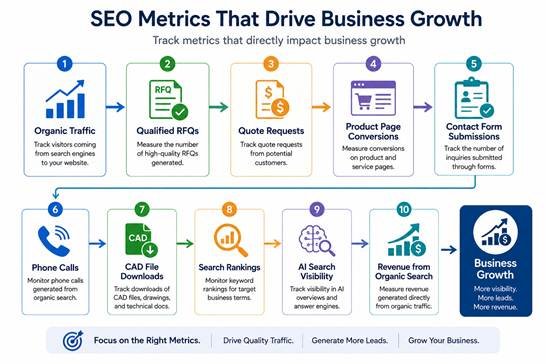
Website traffic alone doesn’t measure success. Monitor RFQs, quote requests, qualified leads, and conversion rates.
🔗 Weak Backlink Strategy
Lack of high-quality backlinks from industry websites, trade associations, and directories limits your website’s authority.
🤝 Poor Sales & SEO Alignment
Without CRM integration and lead tracking, it’s difficult to identify which SEO efforts are driving business growth.
📌 Key Takeaways
✅ Avoid duplicate content.
✅ Target high-intent industrial keywords.
✅ Improve technical SEO regularly.
✅ Track leads and RFQs—not just website traffic.
How to Measure Manufacturing SEO Success
Track metrics that directly impact business growth:
12. Manufacturing SEO Checklist
Use this checklist to audit or plan your manufacturing SEO strategy:
Foundation
- Documented target buyer personas and their search behavior
- Keyword research completed and organized by funnel stage
- Competitor content and keyword gap analysis completed
Technical
- Site speed audited and optimized (images, code, hosting, CDN)
- Mobile responsiveness confirmed across all key pages
- Duplicate content identified and resolved or canonicalized
- Schema markup implemented on product, FAQ, and local pages
- Crawl errors and broken links monitored regularly
On-page & content
- Unique, technically detailed product and service page copy
- Metadata (titles, descriptions, headers) optimized with target keywords
- Content published across awareness, consideration, and decision stages
- Case studies and testimonials with specific, real results
Local & international
- Google Business Profile claimed and optimized for every location
- Consistent NAP data across web, directories, and citations
- Hreflang and localized content in place for each target market (if applicable)
Authority & measurement
- Backlink strategy in place (partnerships, directories, guest content)
- Google Analytics 4 and Search Console configured with conversion tracking
- CRM integration connecting organic traffic to closed deals
- Monthly and quarterly SEO performance reviews scheduled
✅ Did You Know?
Manufacturing SEO is a long-term strategy. Businesses that regularly update content, monitor performance, and improve technical SEO are more likely to achieve sustainable organic growth.
📌 Key Takeaways
✅ Review your SEO strategy regularly.
✅ Measure conversions, not just rankings.
✅ Continue updating content and technical SEO.
✅ Focus on long-term organic growth.
Conclusion:
Manufacturing SEO is more than improving rankings—it’s about connecting your business with engineers, procurement teams, and decision-makers actively searching for your products and services. By combining technical SEO, high-quality content, optimized product pages, and AI Search Optimization, manufacturers can build long-term visibility, generate qualified RFQs, and create a sustainable pipeline of opportunities.
Whether you’re targeting local markets or global buyers, a well-executed manufacturing SEO strategy helps your business stay competitive in an increasingly digital buying environment.
13. FAQs
How is SEO for manufacturing companies different from regular SEO?
Manufacturing SEO targets a small, highly technical audience of engineers, procurement managers, and executives, using specific, spec-driven long-tail keywords rather than broad consumer terms, and it’s measured in RFQs and qualified leads rather than raw traffic.
What keywords should manufacturers target first?
Start with specific, high-intent long-tail keywords tied to your core products, certifications, and applications — these convert better than broad, generic industry terms.
Do we need a PIM (Product Information Management) system for SEO?
Not always, but for manufacturers managing thousands of SKUs across multiple channels, a PIM system makes it far easier to keep product data accurate, unique, and SEO-optimized at scale.
How does AI search change manufacturing SEO?
AI-powered and answer-engine search rewards well-structured, clearly written, authoritative content — meaning the same technical SEO and content fundamentals that help you rank traditionally also improve your visibility in AI-generated answers.
What’s a realistic first KPI to track?
Start with organic traffic to key product/service pages and quote or RFQ form submissions attributed to organic search — these tie SEO activity directly to pipeline.
Ready to Grow Your Manufacturing Business?
Digital BizStar helps manufacturers improve search visibility, attract qualified B2B buyers, and generate more RFQs through data-driven Manufacturing SEO, AI Search Optimization, and digital marketing strategies.