 +91 7550360374
  info@digitalbizstar.com
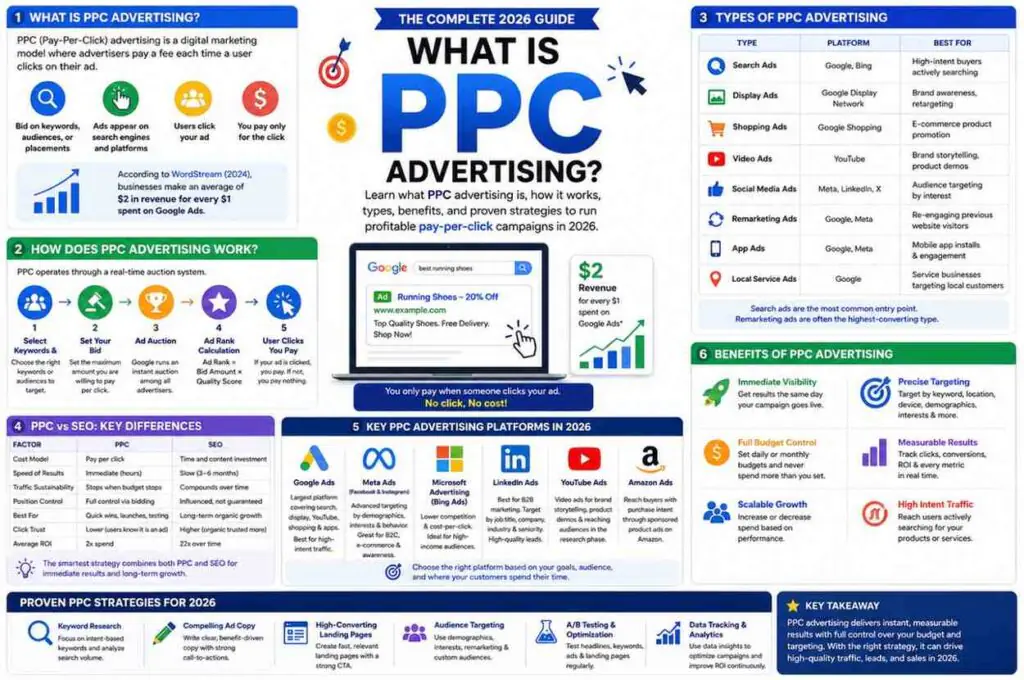
What is PPC Advertising?
PPC advertising (Pay-Per-Click advertising) is a digital marketing model where advertisers pay a fee each time a user clicks on their ad. Instead of earning traffic organically, businesses essentially buy visits to their website by bidding on keywords, audiences, or placements across search engines and social media platforms.
The most widely used PPC platform is Google Ads, where businesses bid to appear at the top of search results for specific keywords. When a user searches that keyword and clicks the ad, the advertiser pays the bid amount — and only for that click, not for impressions.
How Does PPC Advertising Work?
PPC advertising operates through a real-time auction system. Every time a user performs a search or loads a page where ads can appear, an automated auction determines which ads are shown and in what order.
The 5-step PPC process:
Step 1 — Keyword and audience selection Advertisers choose the keywords, demographics, interests, or behaviors they want to target. In search PPC, this means selecting the exact phrases your ideal customer types into Google.
Step 2 — Bid setting Advertisers set a maximum bid — the highest amount they are willing to pay per click. This can be set manually or managed automatically by the platform’s algorithm based on your campaign goal.
Step 3 — Ad auction Every time a qualifying search occurs, Google runs an instant auction among all advertisers targeting that keyword. The auction considers both your bid amount and your Quality Score.
Step 4 — Ad rank calculation Your Ad Rank determines your position on the page. It is calculated as:
Ad Rank = Bid Amount × Quality Score
Quality Score is Google’s rating (1–10) of your ad’s relevance, expected click-through rate, and landing page experience. A high Quality Score means you can rank above competitors while paying less per click.
Step 5 — User clicks and advertiser pays If your ad wins the auction and the user clicks it, you are charged. If no one clicks, you pay nothing — that is the core principle of pay-per-click.
What are the Types of PPC Advertising?
| Type | Platform | Best For |
| Search ads | Google, Bing | High-intent buyers actively searching |
| Display ads | Google Display Network | Brand awareness, retargeting |
| Shopping ads | Google Shopping | E-commerce product promotion |
| Video ads | YouTube | Brand storytelling, product demos |
| Social media ads | Meta, LinkedIn, X | Audience targeting by interest and demographics |
| Remarketing ads | Google, Meta | Re-engaging previous website visitors |
| App ads | Google, Meta | Mobile app installs and engagement |
| Local service ads | Service businesses targeting local customers |
Search ads are the most common entry point for businesses new to PPC. Remarketing ads are often the highest-converting type because they target users who have already shown interest in your brand.
What is the Difference Between PPC and SEO?
This is one of the most commonly asked questions in digital marketing. Both drive traffic from search engines — but through fundamentally different approaches.
| Factor | PPC | SEO |
| Cost model | Pay per click | Time and content investment |
| Speed of results | Immediate (hours) | Slow (3–6 months) |
| Traffic sustainability | Stops when budget stops | Compounds over time |
| Position control | Full control via bidding | Influenced, not guaranteed |
| Best for | Quick wins, product launches, testing | Long-term organic growth |
| Click trust | Lower (users know it is an ad) | Higher (organic results trusted more) |
| Average ROI | 2x spend | 22x over time |
The smartest digital marketing strategy combines both. Use PPC to generate immediate traffic and revenue while SEO builds long-term organic authority in parallel.
What are the Key PPC Advertising Platforms in 2026?
1. Google Ads The largest and most powerful PPC platform in the world. Covers search, display, YouTube, shopping, and app campaigns. Best for businesses of all sizes targeting high-intent search traffic.
2. Meta Ads (Facebook and Instagram) The leading social PPC platform. Unmatched audience targeting by demographics, interests, behaviors, and lookalike audiences. Best for B2C brands, e-commerce, and awareness campaigns.
3. Microsoft Advertising (Bing Ads) Often overlooked but valuable. Bing users tend to be older, higher-income, and less competitive to advertise to — resulting in lower cost-per-click than Google in many industries.
4. LinkedIn Ads The premier B2B PPC platform. Allows targeting by job title, company size, industry, and seniority. Higher cost-per-click than other platforms but delivers the highest quality B2B leads.
5. YouTube Ads Video-based PPC through Google Ads. Ideal for product demonstrations, brand storytelling, and reaching audiences during the research phase of their buying journey.
6. Amazon Ads Essential for e-commerce brands selling on Amazon. Sponsored product ads appear directly in Amazon search results — targeting buyers with purchase intent at the bottom of the funnel.
What are the Benefits of PPC Advertising?
Immediate visibility Unlike SEO, PPC delivers results the same day your campaign goes live. For new businesses, product launches, or time-sensitive promotions, this speed is invaluable.
Precise targeting PPC allows you to target by keyword, location, device, time of day, demographics, interests, and past behavior. No other channel offers this level of audience precision.
Full budget control Set a daily or monthly budget cap and never spend more than you choose. Scale up campaigns that perform and pause those that do not — with complete flexibility.
Measurable ROI Every click, conversion, and rupee spent is tracked. PPC provides clearer attribution than almost any other marketing channel, making it easy to calculate exact return on investment.
Brand visibility even without clicks Even when users do not click your ad, they see your brand name at the top of search results. This impression-based exposure builds brand recognition at no additional cost.
Competitive advantage PPC allows smaller businesses to appear above large competitors in search results — something that can take years to achieve organically through SEO.
What are the Types of PPC Bidding Strategies?
Choosing the right bidding strategy is critical to campaign profitability:
| Bidding Strategy | How it Works | Best For |
| Manual CPC | You set the maximum bid per click | Full control, experienced advertisers |
| Target CPA | Google optimizes bids to hit a cost-per-acquisition goal | Lead generation campaigns |
| Target ROAS | Google optimizes bids to hit a return on ad spend goal | E-commerce campaigns |
| Maximize clicks | Google spends your budget to get the most clicks | Traffic and awareness campaigns |
| Maximize conversions | Google spends your budget to get the most conversions | Conversion-focused campaigns |
| Enhanced CPC | Manual bidding with automated adjustments | Balanced control and automation |
For businesses new to PPC, Maximize Conversions with a defined conversion action is the recommended starting strategy. As data accumulates, transitioning to Target CPA or Target ROAS delivers better long-term efficiency.
What is a Good Quality Score in PPC?
Quality Score is Google’s 1–10 rating of how relevant and useful your ad is to the user searching. It directly impacts both your ad position and your cost per click.
| Quality Score | Meaning | Impact on CPC |
| 1–3 | Poor relevance | Pay significantly more per click |
| 4–6 | Average | Standard market rate |
| 7–8 | Good | Pay less than competitors |
| 9–10 | Excellent | Maximum position at minimum cost |
Three factors that determine Quality Score:
- Expected click-through rate — How likely users are to click your ad based on historical data
- Ad relevance — How closely your ad copy matches the keyword being searched
- Landing page experience — How useful, fast, and relevant your landing page is to the user’s search
Improving Quality Score is the single most effective way to reduce PPC costs while maintaining or improving ad position.
How to Run a Profitable PPC Campaign: 7-Step Strategy
Step 1 — Define your campaign goal Be specific. Are you targeting leads, sales, app installs, phone calls, or store visits? Your goal determines your campaign type, bidding strategy, and success metrics.
Step 2 — Conduct thorough keyword research Use Google Keyword Planner, Ahrefs, or Semrush to identify high-intent keywords with manageable competition. Focus on keywords that signal purchase intent — “buy,” “best,” “near me,” “price,” “service in [city].”
Step 3 — Organize campaigns and ad groups tightly Group keywords by theme into tightly organized ad groups. Each ad group should contain 5–10 closely related keywords. This improves relevance scores and makes optimization easier.
Step 4 — Write compelling ad copy Your headline must match the user’s search intent. Include the keyword in the headline, a clear value proposition in the description, and a strong call to action. Use all available ad extensions — sitelinks, callouts, structured snippets, and call extensions.
Step 5 — Build a dedicated landing page Never send PPC traffic to your homepage. Build a dedicated landing page that directly matches the ad’s promise, loads in under 3 seconds, and contains one clear call to action. Landing page relevance is a major Quality Score factor.
Step 6 — Set negative keywords Add negative keywords to prevent your ads from showing for irrelevant searches. For example, a paid software company should add “free” as a negative keyword to avoid paying for clicks from users who will never convert.
Step 7 — Monitor, test, and optimize Review campaign performance weekly. A/B test ad headlines and descriptions. Adjust bids by device, location, and time of day. Pause underperforming keywords. Scale budgets on campaigns delivering strong ROAS.
What are Common PPC Advertising Mistakes to Avoid?
Sending traffic to the homepage The homepage is for general visitors. PPC users clicked a specific ad with a specific promise — send them to a page that fulfills that promise immediately.
Ignoring negative keywords Without negative keywords, your ads show for irrelevant searches, wasting budget on clicks that will never convert.
Setting and forgetting campaigns PPC requires active management. Campaigns left unmonitored quickly drain budgets on underperforming keywords and outdated bids.
Targeting too broadly Broad match keywords on a limited budget will exhaust your spend on loosely related searches. Use phrase match and exact match to maintain control, especially early in a campaign.
Not tracking conversions properly If your conversion tracking is broken or missing, you cannot optimize toward what actually matters. Set up Google Ads conversion tracking and verify it before spending a single rupee.
Neglecting mobile optimization Over 70% of PPC clicks in India come from mobile devices. If your landing page is not mobile-optimized, you are wasting the majority of your ad spend.
How Much Does PPC Advertising Cost in India?
PPC costs in India vary significantly by industry, competition, and platform:
| Industry | Average CPC on Google Ads (India) |
| Legal services | ₹150 – ₹400 per click |
| Real estate | ₹80 – ₹250 per click |
| Education | ₹40 – ₹120 per click |
| E-commerce | ₹15 – ₹60 per click |
| Healthcare | ₹50 – ₹150 per click |
| IT services | ₹60 – ₹200 per click |
| Restaurants / food | ₹10 – ₹40 per click |
A reasonable starting budget for a small business in India is ₹15,000 – ₹30,000 per month on Google Ads. This provides enough data to optimize campaigns meaningfully within 30 to 60 days.
Conclusion
PPC advertising is one of the most powerful and measurable tools in digital marketing. When set up correctly — with the right keywords, compelling ad copy, optimized landing pages, and consistent monitoring — it delivers immediate, scalable, and trackable results that no other channel can match at the same speed.
For businesses in India looking to grow quickly, generate qualified leads, or dominate search results in a competitive niche, PPC is not optional — it is essential. The key is not just spending money on ads but spending it intelligently, with a clear goal, a structured campaign, and a commitment to continuous optimization.
Frequently Asked Questions
What is PPC advertising in simple terms? PPC advertising is a model where you pay only when someone clicks your ad. You set a budget, choose your target keywords or audience, write your ad, and your ad appears on Google, social media, or other platforms. You are charged only when a real user clicks and visits your website.
What is the difference between PPC and CPC? PPC (Pay-Per-Click) is the advertising model — the overall strategy of paying for clicks. CPC (Cost-Per-Click) is the metric — the actual amount you pay for each individual click. PPC is the system; CPC is the price within that system.
Is PPC worth it for small businesses? Yes, when managed correctly. PPC gives small businesses immediate visibility against larger competitors, full budget control, and precise targeting. Starting with a focused campaign on high-intent local keywords is the most cost-effective approach for small businesses with limited budgets.
How long does it take for PPC to show results? PPC delivers traffic immediately after launch. However, meaningful optimization data — enough to improve campaign performance significantly — typically takes 30 to 60 days and at least 100 conversions to accumulate.
What is a good CTR for PPC ads? A good click-through rate for Google Search Ads is between 3% and 5%. Rates above 5% are considered excellent. Display ads have much lower average CTRs of 0.1% to 0.5% because users are browsing content rather than actively searching.
What is remarketing in PPC? Remarketing (also called retargeting) is a PPC strategy that shows ads specifically to users who have previously visited your website or interacted with your brand. Because these users already know your brand, remarketing ads typically convert at 2 to 3 times the rate of standard prospecting campaigns.
What is the best PPC platform for B2B businesses in India? For B2B businesses in India, Google Ads is the best starting point for capturing search intent. LinkedIn Ads is the best platform for targeting specific job titles, industries, and company sizes — making it ideal for enterprise B2B sales despite its higher cost per click.