 +91 7550360374
  info@digitalbizstar.com
Industrial Equipment SEO
Industrial buyers research specifications, capabilities, certifications, pricing, and supplier experience before submitting an RFQ. Engineers, plant managers, and procurement teams may conduct multiple searches throughout a long buying journey.
SEO for industrial equipment manufacturers helps your website appear for these high-intent searches. By optimizing product pages, technical content, site structure, and applications, manufacturers can improve search visibility, build credibility, attract qualified B2B buyers, and generate more RFQs.
Why Industrial Equipment SEO Is Different
Traditional SEO strategies often focus on broad keywords and high search volumes. Industrial SEO requires a more detailed approach.
Industrial equipment purchases can involve engineers, plant managers, procurement teams, operations leaders, and finance departments, with each stakeholder evaluating different factors before making a decision. Unlike consumer purchases, the buying cycle can often take 6–18 months, as buyers compare technical specifications, supplier capabilities, certifications, pricing, production capacity, lead times, and long-term reliability.
During this extended buying journey, potential customers may visit your website multiple times, compare competitors, download technical information, and search for specific products or applications before submitting an RFQ. Industrial equipment SEO needs to support every stage of this journey — from initial research and technical evaluation to supplier comparison and final purchase consideration.
Industrial buyers search for specific information
Instead of searching for a broad term such as “industrial equipment,” buyers may search for:
- CNC machining equipment for aerospace components
- stainless steel conveyor systems for food processing
- hydraulic press manufacturer
- custom industrial automation equipment
- industrial equipment supplier in Texas
- ISO 9001 certified machinery manufacturer
These searches reveal much more about the buyer’s needs and purchase intent.
Technical credibility matters
Industrial buyers need accurate and detailed information before contacting a supplier. Your website should clearly communicate:
- Product specifications
- Materials and finishes
- Dimensions and tolerances
- Production capacity
- Industry certifications and compliance standards
- Applications
- Industries served
- Manufacturing processes
- Delivery capabilities
- Quality standards
For manufacturers serving regulated or highly specialized industries, certifications can play an important role in the supplier evaluation process. Clearly showcase relevant credentials such as ISO 9001, AS9100, ITAR, and IATF 16949 where applicable. These details can help buyers quickly determine whether your company meets their quality, aerospace, defense, or automotive supplier requirements.
A page filled with generic statements such as “high-quality products” or “reliable solutions” does little to help search engines or technical buyers. Specific information about your capabilities, certifications, specifications, and applications provides much more value and helps establish technical credibility.
7 Core Pillars of Industrial Equipment SEO
1. Target the Keywords Your Buyers Actually Use
Keyword research should start with your products, capabilities, applications, and buyer requirements.
Instead of focusing only on broad keywords, identify combinations involving:
- Product type
- Material
- Size or capacity
- Application
- Industry
- Certification
- Location
- Manufacturing process
- Technical specification
For example:
Broad:
industrial machinery
More specific:
CNC machining equipment for aerospace manufacturers
The second keyword may have lower search volume, but the person searching it is much more likely to be a qualified prospect.
2. Optimize Product and Capability Pages
Your product pages should do more than display a product name and a short description.
Create detailed pages that explain:
- What the equipment does
- Key specifications
- Available configurations
- Materials supported
- Production capacity
- Applications
- Industries served
- Certifications
- Quality standards
- Related products
- RFQ or enquiry options
Technical buyers should be able to find the information they need without immediately having to contact sales.
3. Build a Search-Friendly Website Structure
Industrial manufacturers may have hundreds or thousands of products, variations, specifications, and applications.
Without a clear website structure, search engines may struggle to understand which pages are important.
A strong structure could look like:
Products → Product Category → Product → Application
For example:
Industrial Equipment → CNC Equipment → CNC Turning Machine → Aerospace Applications
This makes the website easier for both search engines and buyers to navigate.
You should also review:
- Internal linking
- XML sitemap
- Canonical URLs
- Duplicate product pages
- URL structure
- Page speed
- Mobile usability
- Schema markup
- Crawlability
4. Create Content for Every Stage of the Buying Journey
Industrial buyers don’t immediately submit an RFQ.
They may first search:
Research stage:
“What is CNC turning?”
Evaluation stage:
“CNC turning vs CNC milling”
Supplier research:
“CNC machining manufacturer for aerospace”
Purchase stage:
“CNC machining supplier Ohio ISO 9001”
Your content should support each stage.
Useful content formats include:
- Technical guides
- Product comparisons
- Application guides
- Industry pages
- Case studies
- FAQs
- Specification guides
- Maintenance guides
- Buying guides
This helps your website become a useful resource instead of simply an online brochure.
5. Use Local and Regional SEO
Even manufacturers serving customers nationally or internationally can benefit from location-based SEO.
Buyers may search for:
- industrial equipment manufacturers near me
- industrial equipment suppliers in Texas
- CNC equipment manufacturers in Ohio
- machinery manufacturers in California
Create useful location pages when you genuinely serve those markets.
Don’t create dozens of identical city pages simply to rank for locations. Each location page should provide real information about your capabilities, facility, service area, or customer base.
6. Build Industry Authority
For industrial manufacturers, authority is built through relevant industry relationships and trusted manufacturing platforms. Being featured in industrial directories, trade associations, manufacturing publications, and supplier networks can help strengthen visibility among engineers, procurement teams, OEMs, and other B2B buyers.
Manufacturers can strengthen their online authority through:
- Industrial directories such as Thomasnet, MFG.com, Engineering.com, and IndustryNet
- Trade associations and industry organizations
- Manufacturing publications
- Relevant supplier directories
- Industry partnerships
- Technical articles and expert contributions
- Relevant industry backlinks
- Customer case studies and supplier references
Being listed on relevant industrial platforms can help improve your company’s visibility among potential buyers while also creating relevant references back to your website.
For example, a manufacturer listed on Thomasnet or IndustryNet may gain additional exposure when procurement teams and engineers are researching potential suppliers. Similarly, contributing technical content to relevant manufacturing publications or industry platforms can strengthen both brand credibility and your website’s authority.
The goal is not to collect as many backlinks as possible. Focus on relevant, trustworthy industry sources that can strengthen your visibility with the engineers, procurement teams, OEMs, and manufacturers you want to reach.
7. Optimize for AI Search and Google AI Overviews
Industrial buyers are increasingly using AI tools to research products, suppliers, and technical questions.
Your website should make important information easy for both search engines and AI systems to understand.
Use:
- Clear headings
- Direct answers
- Structured technical information
- FAQ sections
- Authoritative content
- Product and organization schema
- Consistent company information
- Detailed product and capability pages
The goal is simple: make it easy for search engines and AI systems to understand what you manufacture, who you serve, where you operate, and what makes your capabilities different.
How Long Does Industrial Equipment SEO Take?
Industrial SEO is a long-term strategy because manufacturers often have complex websites, highly specific keywords, and long buying cycles. Many manufacturers can begin seeing measurable ranking movement within 3–6 months, while meaningful RFQ growth typically develops over 6–12 months. Results vary depending on competition, website condition, content quality, technical SEO, authority, and the number of products or markets being targeted.
What Does Industrial Equipment SEO Cost?
SEO costs vary based on the size of your website, number of products, competition, content requirements, technical complexity, and target markets.
As a general industry range:
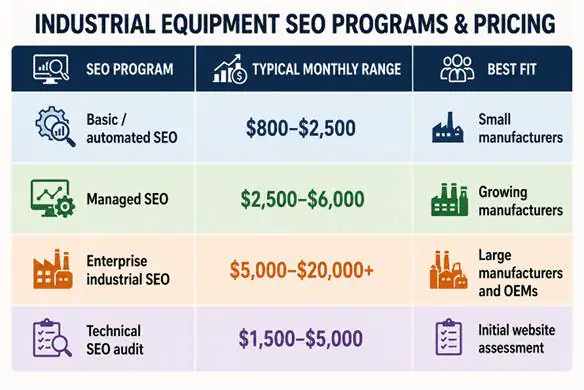
These are general market ranges rather than fixed prices.
A manufacturer with 40 products may need a very different SEO program from an OEM with thousands of product variations.
The important question isn’t simply “How much does SEO cost?”
It’s “What level of SEO investment is required to generate qualified opportunities from our target market?”
How Digital BizStar Approaches Industrial Equipment SEO
At Digital BizStar, we focus on connecting SEO with actual business opportunities through manufacturing SEO, technical SEO, content optimization, and B2B lead generation.
Our approach can include:
- Researching how your target buyers search
- Mapping keywords to products and capabilities
- Auditing technical SEO and website architecture
- Optimizing product and capability pages
- Creating application and industry-specific content
- Improving internal linking and site structure
- Building relevant industry authority
- Optimizing content for AI search
- Tracking organic traffic, rankings, enquiries, and RFQs
The objective isn’t simply to generate more website traffic.
It’s to help manufacturers attract engineers, procurement teams, plant managers, OEMs, distributors, and other qualified B2B buyers who are actively looking for their products or capabilities.
Frequently Asked Questions
How long does SEO take for an industrial equipment manufacturer?
SEO results depend on competition, website condition, content quality, authority, and the target keywords. Many manufacturers can begin seeing ranking improvements within a few months, while meaningful organic lead growth often takes longer.
What keywords should industrial equipment manufacturers target?
Start with high-intent keywords related to your products, applications, industries, specifications, certifications, materials, capabilities, and service locations.
Specific long-tail keywords are often more valuable than broad terms because they can indicate stronger buying intent.
Is SEO better than Google Ads for industrial equipment manufacturers?
SEO and Google Ads serve different purposes.
Google Ads can generate immediate visibility for selected keywords, while SEO can build long-term organic visibility without paying for every click.
Many manufacturers benefit from using both strategies.
Does local SEO matter for manufacturers?
Yes. Buyers may search for suppliers based on location, particularly when shipping costs, lead times, site visits, installation, or ongoing service are important.
How is industrial equipment SEO different from regular B2B SEO?
Industrial equipment SEO requires a stronger focus on technical information, product specifications, applications, certifications, complex website structures, and long B2B buying cycles.
The content needs to satisfy both search engines and technically informed buyers.
What is a realistic SEO budget for a manufacturer?
There is no single budget that works for every manufacturer. The investment depends on the number of products, website complexity, competition, target locations, content requirements, and business goals.
A smaller manufacturer may need a focused SEO program, while a large OEM with thousands of products may require a much larger technical and content operation.
Conclusion
Your potential customers are already searching for equipment, manufacturing capabilities, suppliers, specifications, and applications.
The question is whether they find your company or a competitor.
A well-planned industrial equipment SEO strategy can help your website appear throughout the buying journey — from early technical research to supplier evaluation and RFQ generation.
For manufacturers, SEO isn’t just about rankings.
It’s about being visible when the right buyer is ready to evaluate what you can manufacture.
Ready to improve your industrial search visibility and generate more qualified RFQs? Explore Digital BizStar’s SEO services or contact our team to discuss your manufacturing growth goals.