 +91 7550360374
  info@digitalbizstar.com
SEO for Ceramic Manufacturers
Ceramic manufacturing is one of the world’s oldest industries, but many manufacturers still rely on outdated websites that function as digital catalogs with little ability to generate leads. Meanwhile, the global ceramic tiles market is projected to reach USD 226.4 billion in 2025 and grow at a 6.6% CAGR through 2033 .
Today’s buyers—including architects, procurement teams, OEMs, and dealers—research suppliers online, compare specifications, and shortlist manufacturers before making contact. This guide explains the SEO strategies that help ceramic, sanitaryware, technical ceramics, marble, and granite manufacturers improve online visibility, attract qualified buyers, and stay ahead in an increasingly digital market.
Looking to improve your online visibility? Explore our Manufacturing SEO Services to learn how Digital BizStar helps industrial manufacturers generate qualified RFQs through data-driven SEO strategies.
Quick Summery:
- Why SEO is essential for ceramic manufacturers
- How buyers search for ceramic products
- Technical SEO best practices
- AI Search Optimization strategies
- A 90-day implementation roadmap
- Key metrics to measure success
Who Should Read This Guide?
This guide is designed for:
- Ceramic tile manufacturers
- Porcelain and vitrified tile manufacturers
- Sanitaryware manufacturers
- Technical ceramic manufacturers
- Marble and granite suppliers
- Ceramic exporters
- Marketing managers in manufacturing companies
- Business owners looking to generate qualified RFQs through SEO
1. Why Ceramic Manufacturers Need SEO to Win More RFQs
Ceramic buyers rarely start with a brand name. They start with a need: a slip rating, a size, a certification, a finish. If your site isn’t built around those exact search terms, Google simply won’t connect you to the buyer — no matter how good your factory is.
This matters more than ever because of how B2B buying itself has changed. According to Gartner’s most recent buyer research, B2B purchasers now complete roughly 80% of their buying journey before ever contacting a vendor directly, consulting an average of seven different information sources along the way.
Nearly half — 45% — now use generative AI tools like ChatGPT or Gemini at some point in that research. If your product pages, spec sheets, and certifications aren’t indexed and structured clearly, you’re invisible for the majority of the decision — not just the final call.
2. How Buyers Actually Search — Match Their Language, Not Your Brochure
Real buyer searches look like this:
- An architect searching for anti-slip ceramic tiles rated for a commercial kitchen floor
- A dealer looking for a specific size and finish, such as 600x1200mm matte vitrified tiles
- A contractor searching for ISO-certified ceramic manufacturers in a specific city or region
- A procurement manager comparing “porcelain vs. vitrified vs. ceramic” for a bid specification
These are long-tail, high-intent searches. Manufacturers who write generic copy — “premium quality tiles,” “leading ceramic manufacturer” — never surface for any of them. Manufacturers who build pages around exact specs, finishes, certifications, and applications do.
How Different Ceramic Buyers Search Online
Different buyers use different search terms depending on their role, project requirements, and purchasing goals. Understanding these search patterns helps you create content that matches buyer intent and attracts qualified traffic.
| Buyer Type | Typical Search Query | What They’re Looking For |
| 🏗️ Architect | Anti-slip ceramic tiles for hospitals | Safety ratings, certifications, and application suitability |
| 🛒 Dealer / Distributor | 600×1200 vitrified tiles supplier | Product size, finish, availability, and wholesale pricing |
| 🏢 Procurement Manager | ISO-certified ceramic manufacturer India | Certified manufacturers with production capabilities and compliance |
| 🌍 Export Buyer | Ceramic tile exporter for Middle East | Export experience, international standards, and logistics support |
| 👷 Contractor | R11 anti-skid porcelain tiles for commercial kitchens | Durable products that meet project specifications |
| 🏭 OEM Buyer | Technical ceramic components manufacturer | Precision-engineered ceramic parts with custom manufacturing capabilities |
| 🏨 Interior Designer | Matte porcelain tiles for luxury hotels | Design aesthetics, finishes, colours, and premium collections |
| 🏠 Home Builder | Best ceramic tile manufacturer for residential projects | Reliable suppliers offering quality products and consistent supply |
The fix: Every product page should speak the buyer’s language — size, finish, slip rating, material class, compliance standard — not just brand positioning.
💡 Digital BizStar Tip
Don’t target only broad keywords like “ceramic tiles.” Create dedicated pages around product sizes, finishes, applications, certifications, and technical specifications. These high-intent searches attract buyers who are closer to making a purchase
3. Site Architecture That Search Engines (and Buyers) Can Actually Navigate
A ceramic manufacturer’s site should mirror how a buyer thinks, not how the factory is organized internally. A well-structured site typically includes:
- Material hub pages — porcelain, vitrified, quarry, technical ceramics, sanitaryware — that act as category anchors
- Finish, size, and application pages — e.g., matte finish, R11 slip-resistant, 12×24 porcelain — that capture narrow, high-intent searches
- Compliance and spec pages — dedicated pages for ANSI, ASTM, ISO, BIS, or EN standards, since compliance is often the deciding factor for institutional and export buyers
- Dealer and regional pages — built for local SEO and B2B distributor discovery
- Case studies and technical resources — real installations, BOQs, and application guides that build trust with architects and specifiers
Flat, crawlable URLs (e.g. /tiles/porcelain/matte-600×1200), correct canonical tags for size/finish variants, and clean category structures all matter here — large catalogs are especially prone to duplicate-content issues if this isn’t handled early.
💡 Digital BizStar Tip
Organize your website the way buyers search—not the way your factory is structured. Well-defined category pages and application-based landing pages make it easier for both search engines and potential customers to find the right products.
4. Technical SEO That Helps Ceramic Product Pages Rank Higher
Ceramic manufacturers deal with something few other industries do at this scale: huge, image-heavy catalogs and thousands of PDF spec sheets. That creates specific technical SEO requirements:
- Separate XML sitemaps for products and resource PDFs, so search engines prioritize crawling product pages first
- Text-based, not scanned, PDFs, with canonical links pointing back to the live product page
- Schema markup (Product, Offer, AggregateRating via JSON-LD) so listings can show rich snippets — price, availability, ratings
- CDN delivery for image- and PDF-heavy catalogs, since page speed directly affects both rankings and buyer patience
- Descriptive, keyword-rich image filenames and alt text — “porcelain-tile-12×24-matte-charcoal.jpg” instead of “IMG4021.jpg” — which also feeds Google Image and Lens searches, a channel architects increasingly use to source visually.
💡 Digital BizStar Tip
Your product specifications are valuable SEO assets. Optimize PDFs, use Product Schema, descriptive image alt text, and fast-loading pages to improve visibility in Google Search, Google Images, and AI-powered search platforms.
Ceramic Manufacturer Technical SEO Checklist
Use this checklist to ensure your website is optimized for search engines, AI search platforms, and B2B buyers.
| ✔ Checklist Item | Why It Matters |
| ✅ Product Schema (JSON-LD) | Helps Google display rich results such as product details and ratings. |
| ✅ Optimized XML Sitemap | Makes it easier for search engines to discover and index your product and resource pages. |
| ✅ PDF Optimization | Use searchable PDFs with canonical links back to the relevant product pages. |
| ✅ Descriptive Image Alt Text | Improves accessibility and helps your images rank in Google Images and visual search. |
| ✅ Fast Loading Website | Better page speed improves user experience and search rankings. |
| ✅ Canonical URLs | Prevents duplicate content issues caused by product variants. |
| ✅ Mobile-Friendly Design | Ensures buyers can easily browse products on smartphones and tablets. |
| ✅ Clean URL Structure | Use descriptive URLs such as /porcelain-tiles/matte-600×1200 for better indexing. |
| ✅ Internal Linking | Connect related products, categories, and technical resources to improve navigation and SEO. |
| ✅ Google Search Console Setup | Monitor indexing, search performance, and technical issues regularly. |
5. Visual Search and Local SEO for Showrooms and Distribution Points
Ceramics and natural stone are visual products, and buyers evaluate them visually before they ever request a sample. Two tactics stand out:
- Room visualizers and AR previews — letting a buyer or designer see a tile or slab in a real kitchen or bathroom setting increases both engagement and time-on-page, both of which correlate with better rankings for long-tail visual searches.
- Google Business Profile optimization for every showroom, plant, or distribution center — accurate NAP (name, address, phone), correct categories (e.g., “Ceramic Tile Supplier,” “Stone Supplier”), regularly updated photos, and active Q&A. For marble, granite, and sanitaryware retailers specifically, local search is often the single largest source of walk-in and quote-request traffic, since these are frequently evaluated in person before purchase.
💡 Digital BizStar Tip
Keep every showroom and manufacturing location updated on Google Business Profile with accurate contact details, recent photos, and customer reviews. Strong local signals help attract nearby dealers, contractors, and architects.
6. Content That Architects and Procurement Teams Actually Save and Reuse
Ceramic buyers — especially architects, specifiers, and OEM procurement teams — don’t convert on product pages alone. They convert on trust, built through:
- Technical explainers on R-ratings, DCOF (dynamic coefficient of friction), and EN/ISO standards
- Application guides for verticals like healthcare, hospitality, or industrial flooring
- Case studies with spec sheets and Bills of Quantities (BOQs) — these are gold for SEO because they contain exactly the technical language buyers search for, and gold for conversion because they de-risk the decision
- White papers for industrial/technical ceramics and OEM buyers, positioning the manufacturer as a subject-matter authority rather than just a catalog
This kind of content also has an outsized effect on backlinks — architecture and design publications, trade associations (e.g., tile and stone industry bodies), and supplier/contractor partners are far more likely to link to a detailed case study than to a product listing.
💡 Digital BizStar Tip
Educational content builds trust. Publish technical guides, compliance resources, case studies, and application-specific articles to answer buyer questions before they contact your sales team.
Related Service: Need technical content that educates buyers and improves search visibility? Explore our Technical Content Marketing services to create industry-focused articles, case studies, and technical resources that drive organic traffic.
7. Special Considerations for Marble, Granite, and Sanitaryware
Ceramics don’t exist in isolation — most manufacturers and distributors in this space also sell or compete against natural stone (marble, granite) and sanitaryware, and each has its own search behavior:
- Marble and granite searches skew heavily toward showroom visits and local intent (“granite slabs near me,” “marble supplier [city]”), so local SEO, Google Business Profile depth, and consistent NAP across directories carry more weight than they do for pure industrial ceramics.
- Sanitaryware searches blend design intent (“wall-hung toilet matte black”) with technical intent (flush rate, water-saving certification), so product pages need both a design-forward gallery and a specs tab.
- Cross-category manufacturers benefit from building shared compliance and technical-standards content once (e.g., a single hub on water efficiency certifications) and linking it across ceramics, sanitaryware, and stone product lines — this consolidates authority instead of splitting it across near-duplicate pages.
8. Marketplaces, Directories, and Link Earning
Your own website is not the only place buyers look. Listing consistently on B2B directories — ThomasNet, Houzz Pro, Build.com, and regional equivalents — extends reach to buyers who never land on your site directly. The details matter:
- Keep product names, dimensions, and descriptions identical across your website and every directory listing to avoid diluting SEO value through near-duplicate content
- Track referral traffic and quote requests per directory, not just in aggregate, so budget and effort go to the listings that actually convert
- Earn backlinks through trade association partnerships, design-magazine features, and joint case studies with contractors or distributors — these carry more authority in Google’s eyes than generic directory links
💡 Digital BizStar Tip
Focus on earning backlinks from industry associations, trade publications, architects, and distributor websites. These authoritative links provide far more SEO value than submitting your site to low-quality directories.
9. The New Frontier: Showing Up in AI Search, Not Just Google
This is the piece missing from most ceramics-industry SEO guides today — and it’s becoming one of the most important.
With 45% of B2B buyers now using generative AI tools during their research (Gartner, 2026) and roughly 69% still turning to a human or a sales rep to validate what the AI told them, ceramic manufacturers now need to optimize for two audiences at once: search engines and AI answer engines (ChatGPT, Gemini, Perplexity, Google AI Overviews).
Practical implications for ceramic manufacturers:
- Structured, factual, well-cited technical content (spec sheets, compliance data, clearly labeled dimensions and certifications) is far more likely to be pulled into an AI-generated answer than marketing copy — AI systems favor content that reads as a direct, verifiable answer to a specific question.
- FAQ-formatted content (“What R-rating do I need for a commercial kitchen floor?”) mirrors how buyers phrase questions to AI tools, increasing the odds of being cited as a source.
- Being the cited source in an AI answer — not just being summarized without attribution — is becoming a genuine trust signal, since buyers increasingly report lower confidence in AI answers that can’t be traced back to a credible source.
Manufacturers who treat this as a content-structure problem now — clear headings, direct answers, sourced data — will have a real head start once AI-driven discovery becomes a standard part of industrial procurement, the way search engines did a decade ago.
💡 Digital BizStar Tip
AI platforms prefer content that is clear, structured, and fact-based. Use descriptive headings, FAQs, specifications, certifications, and trusted data sources to increase the chances of your content being cited in AI-generated answers.
Related Services: Strengthen your digital presence with our AI Search Optimization solutions and LinkedIn Marketing strategies to increase visibility across AI platforms, search engines, and professional networks.
10. Market Data Snapshot: Numbers Most Ceramics SEO Guides Don’t Mention
A few data points worth building your strategy and content calendar around:
- Market size: The global ceramic tiles market was valued at roughly USD 226.4 billion in 2025, growing at a 6.6% CAGR through 2033 (Grand View Research). Asia Pacific alone commands close to 69% of global market share.
- Channel shift: Online retail and research channels for tiles are growing at roughly 10.5% CAGR — nearly double the growth rate of the overall market — as buyers increasingly research, visualize, and even order samples online before any showroom visit (Mordor Intelligence).
- India’s manufacturing weight: Morbi, Gujarat is the epicenter of Indian ceramic tile production, home to 1,100–1,800+ factories depending on the estimate, producing an estimated 70–90% of India’s national tile output and exporting to well over 100 countries. This concentration means Morbi-based and India-sourced manufacturers are competing globally almost entirely on digital discoverability, not geography.
- Buyer research depth: B2B buyers now consult an average of seven distinct sources before shortlisting a supplier (Gartner, 2026), and 95% of the time, the vendor that ultimately wins the deal was already on the buyer’s shortlist on “day one” (6sense) — reinforcing why early-stage visibility (search, AI answers, directories) matters more than late-funnel sales effort.
- Buying-committee size: Complex industrial and construction-material purchases now typically involve 6 to 11 stakeholders — architects, procurement, finance, and operations — meaning your content needs to satisfy several very different reading levels: technical spec buyers, commercial decision-makers, and design-focused evaluators, often on the same page.
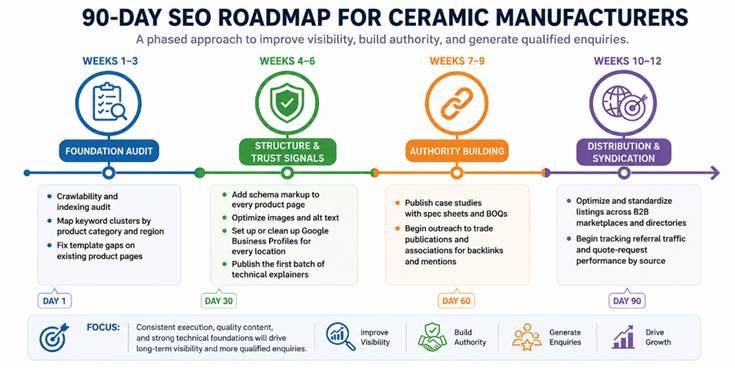
11. A Realistic 90-Day SEO Roadmap
💡 Digital BizStar Tip
SEO is a long-term investment. Consistently improving your website, publishing technical content, and earning industry authority delivers sustainable growth in organic traffic and qualified RFQs.
12. What to Track
- Qualified leads and sample-order requests
- Spec sheet downloads and dealer sign-ups
- Organic traffic segmented by buyer type (architect, dealer, procurement)
- Keyword visibility for compliance and product-spec terms (e.g., “R11,” “ISO 10545,” “ANSI A137.1”)
- Citations/appearances in AI-generated answers for category and compliance questions (an emerging but increasingly trackable metric)
Conclusion:
At Digital BizStar, we help ceramic, sanitaryware, marble, and granite manufacturers increase online visibility, generate qualified RFQs, and build long-term digital authority through Manufacturing SEO, AI Search Optimization, Technical Content Marketing, and LinkedIn Marketing. Explore our services to discover how we can create a growth strategy tailored to your products, markets, and business goals.
Frequently Asked Questions (FAQs)
Can SEO generate export enquiries for ceramic manufacturers?
Absolutely. A well-planned SEO strategy helps your products appear in searches made by international buyers looking for ceramic tile exporters, sanitaryware suppliers, and technical ceramic manufacturers. Optimizing product pages, certifications, export capabilities, and industry-specific keywords can attract qualified enquiries from global markets.
How does AI Search Optimization help ceramic manufacturers?
AI Search Optimization ensures your website is structured so AI-powered platforms like ChatGPT, Google AI Overviews, Gemini, and Perplexity can understand and reference your content. Using clear headings, FAQs, technical specifications, certifications, structured data, and factual content increases your chances of being cited in AI-generated answers.
Why are technical product pages important for SEO?
Technical product pages provide detailed information such as dimensions, finishes, certifications, material specifications, and applications. This helps search engines understand your products while giving architects, procurement teams, and engineers the information they need to make informed purchasing decisions.
What are the most important SEO metrics for ceramic manufacturers?
The most valuable metrics include:
- Organic website traffic
- Qualified RFQs and enquiry submissions
- Product page rankings
- Keyword visibility
- Spec sheet downloads
- Google Business Profile performance
- Export enquiries
- AI search citations and mentions
Tracking these KPIs helps measure the impact of your SEO strategy and identify opportunities for continuous improvement.
Why should ceramic manufacturers invest in SEO instead of relying only on trade shows?
Trade shows generate opportunities for a limited period, while SEO helps your business attract potential buyers throughout the year. A strong online presence ensures architects, contractors, dealers, procurement teams, and export buyers can discover your products whenever they are actively searching, resulting in a consistent pipeline of qualified leads.