 +91 7550360374
  info@digitalbizstar.com
Manufacturing SEO Company: 12 Reasons Your Industrial Website Isn’t Ranking
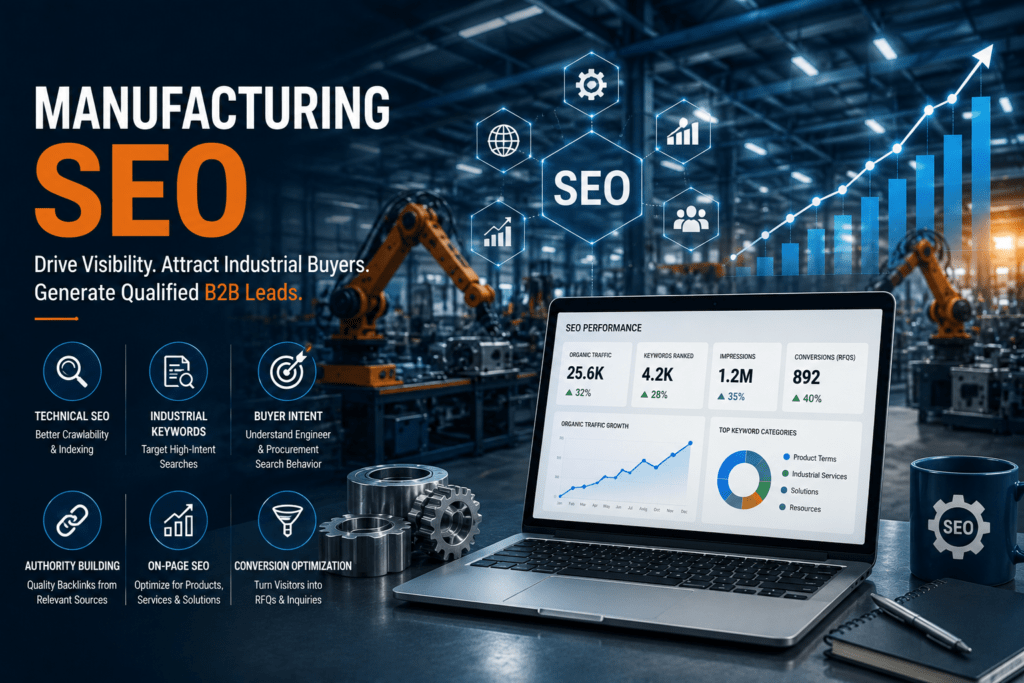
A strong manufacturing business needs more than quality products—it needs digital visibility. Digital Bizstar’s Manufacturing SEO strategies combine technical SEO, buyer-focused content, and conversion optimization to help manufacturers improve rankings, attract qualified B2B traffic, and generate consistent enquiries and RFQs.
Why Manufacturing SEO Is Different
Manufacturing SEO isn’t the same as local business SEO or eCommerce optimization.
Industrial buyers conduct detailed research before contacting suppliers. Their searches often include:
- Custom component manufacturers
- Precision machining services
- Industrial automation solutions
- OEM manufacturing partners
- Contract manufacturing companies
- Material specifications
- Industry certifications
Your SEO strategy should focus on technical expertise, product capability, and buyer intent—not generic marketing tactics.
Manufacturing SEO works best when combined with a strong B2B Digital Marketing strategy that connects search visibility with sales opportunities.
| Buyer Stage | Buyer Intent | Website Content Required | SEO Focus |
| Awareness | “What solutions are available?” | Industry guides, educational blogs, FAQs | Informational keywords |
| Research | “Which manufacturer can solve my requirement?” | Product pages, capability pages, comparison content | Commercial keywords |
| Evaluation | “Can this supplier meet our standards?” | Certifications, case studies, technical documents | Trust signals and authority |
| Decision | “How do I request a quotation?” | RFQ forms, contact pages, enquiry CTAs | Conversion optimization |
1. You’re Targeting the Wrong Keywords
Many manufacturers optimize for broad phrases like:
- Manufacturing company
- Industrial services
- Engineering solutions
These keywords are highly competitive and often too generic.
Instead, focus on specific buyer-intent searches such as:
- Stainless steel fabrication company
- Precision CNC machining manufacturer
- Custom rubber moulding manufacturer
- Industrial conveyor manufacturer
- Pharmaceutical equipment manufacturer
Long-tail keywords typically attract visitors who are much closer to requesting a quotation.
| SEO Issue | What Happens | Business Impact | Recommended Fix |
| Poor keyword targeting | Website ranks for generic terms instead of buyer-intent searches | Low-quality traffic and fewer enquiries | Build keyword strategy around products, applications, and industries |
| Thin product pages | Search engines lack enough context about your capabilities | Lower rankings for product-specific searches | Create detailed product and capability pages |
| Poor technical SEO | Crawlers struggle to understand website structure | Reduced visibility in search results | Fix indexing, speed, schema, and site architecture issues |
| No industry-specific content | Website fails to demonstrate expertise | Missed opportunities during buyer research | Publish technical guides, case studies, and application-based content |
| Weak internal linking | Important pages receive less authority | Poor ranking distribution across the website | Create logical topic clusters and internal links |
| No conversion optimization | Visitors cannot easily request information | Traffic does not convert into RFQs | Add enquiry forms, CTAs, and downloadable resources |
How to Fix It
- Perform keyword research for every product line.
- Target industry-specific terminology.
- Build pages around buyer intent rather than company descriptions.
2. Your Website Doesn’t Explain What You Manufacture
Many manufacturing websites emphasize company history instead of products and capabilities.
Visitors should immediately understand:
- What you manufacture
- Industries served
- Materials used
- Production capabilities
- Certifications
- Industries supported
Clear messaging improves both SEO and conversions.
3. Your Product Pages Are Too Thin
Many industrial websites have product pages containing only:
- Product name
- One image
- Short description
Google rewards pages that demonstrate expertise.
Create detailed pages including:
- Technical specifications
- Manufacturing process
- Material options
- Quality standards
- Applications
- Industries served
- Frequently asked questions
- Downloadable brochures
4. You’re Ignoring Technical SEO
Technical issues prevent search engines from properly understanding your website.
Common problems include:
- Broken links
- Slow loading pages
- Duplicate URLs
- Missing canonical tags
- Crawl errors
- Poor mobile usability
Technical SEO creates the foundation that allows content to rank effectively.
5. Your Website Loads Too Slowly
Industrial buyers expect websites to load quickly regardless of device.
Slow websites often suffer from:
- Large images
- Unoptimized code
- Poor hosting
- Excessive plugins
- Uncompressed files
Improving page speed benefits both user experience and search rankings.
6. Your Website Isn’t Built Around Buyer Journeys
Different visitors require different information.
For example:
Engineers want
- Technical specifications
- Drawings
- Material information
Procurement Teams want
- Certifications
- Production capacity
- Delivery timelines
Business Owners want
- Industry experience
- Success stories
- Competitive advantages
Creating content for each audience improves engagement and lead generation.
7. You’re Missing Capability Pages
One of the biggest SEO opportunities for manufacturers is creating dedicated capability pages.
Instead of one generic “Services” page, create separate pages for:
- CNC Machining
- Laser Cutting
- Sheet Metal Fabrication
- Injection Moulding
- Industrial Automation
- Assembly Services
- Surface Treatment
Each page should target a unique keyword and explain the complete manufacturing process.
Capability pages are one part of a complete SEO framework. A strong Technical SEO strategy ensures search engines can properly crawl, understand, and rank these pages.
| SEO Area | Priority Level | Goal |
| Technical SEO Audit | High | Improve crawlability and website performance |
| Product Page Optimization | High | Rank for specific manufacturing searches |
| Capability Pages | High | Capture service-based buyer searches |
| Industrial Content Marketing | Medium | Build expertise and search authority |
| Schema Implementation | Medium | Improve search engine understanding |
| Backlink Building | Medium | Increase domain authority |
| Conversion Optimization | High | Convert visitors into RFQs |
8. You Don’t Demonstrate Industry Expertise
Search engines increasingly reward websites that demonstrate genuine expertise.
Share knowledge through:
- Manufacturing guides
- Process explanations
- Material comparisons
- Industry regulations
- Quality standards
- Engineering best practices
Educational content builds authority while helping potential customers during the research phase.
9. You’re Not Optimizing for AI Search
Search behaviour is evolving rapidly.
Potential buyers now ask conversational questions such as:
- Which manufacturer is best for custom metal fabrication?
- Who offers ISO-certified precision machining?
- What manufacturer supplies OEM components for automotive companies?
To improve visibility in AI-powered search experiences:
- Answer common industry questions clearly.
- Structure content with descriptive headings.
- Include FAQs.
- Use schema markup where appropriate.
- Publish original insights supported by real manufacturing experience.
10. Your Website Lacks Trust Signals
Industrial buyers want reassurance before contacting a supplier.
Strengthen trust by showcasing:
- ISO certifications
- Industry memberships
- Manufacturing facility photographs
- Client testimonials
- Case studies
- Awards
- Years of experience
- Quality assurance processes
Trust signals improve both user confidence and conversion rates.
11. You’re Not Measuring the Right SEO Metrics
Many companies focus only on rankings.
Instead, measure business outcomes such as:
- Qualified enquiries
- RFQ submissions
- Organic lead growth
- Product page conversions
- Contact form submissions
- Phone enquiries
- Revenue generated from organic search
SEO success should be tied to business growth—not vanity metrics.
12. You’re Treating SEO as a One-Time Project
Search engine optimization is an ongoing process.
Competitors continue publishing content, improving websites, and earning backlinks.
Successful manufacturers regularly:
- Update product pages
- Publish new industry content
- Improve technical performance
- Refresh outdated information
- Expand keyword coverage
- Monitor competitor activity
Consistent improvement leads to sustainable long-term visibility.
What a Manufacturing SEO Company Should Deliver
When selecting an SEO partner, look for one that understands industrial buying behaviour and focuses on measurable business outcomes.
A manufacturing-focused SEO strategy should include:
- Comprehensive SEO audits
- Industrial keyword research
- Technical SEO improvements
- Capability page optimization
- Product page optimization
- Content strategy for engineers and procurement teams
- Internal linking architecture
- Schema markup implementation
- Local and international SEO (if applicable)
- Performance tracking tied to leads and enquiries
The objective isn’t simply to increase traffic—it’s to generate qualified business opportunities.
| Area | Without SEO Optimization | With Manufacturing SEO Strategy |
| Search Visibility | Limited presence for industrial keywords | Improved rankings for targeted searches |
| Website Traffic | General visitors with low intent | Qualified B2B visitors |
| Product Discovery | Buyers struggle to find capabilities | Dedicated pages improve discovery |
| Lead Generation | Reliance on referrals and outbound sales | Consistent organic enquiries |
| Sales Support | Website acts as a brochure | Website works as a lead-generation channel |
SEO success for manufacturers is measured by more than rankings. The goal is to attract decision-makers, generate RFQs, and create predictable B2B opportunities through an integrated digital marketing strategy for manufacturing companies.
Final Thoughts
Manufacturing growth starts with digital visibility. When your industrial website fails to rank, the cause is often a combination of technical SEO gaps, weak content structure, and poor alignment with buyer search intent. Digital Bizstar, a specialized Manufacturing SEO Company, helps manufacturers optimize their digital foundation, improve search visibility, attract qualified B2B buyers, and generate consistent RFQs through data-driven SEO strategies.
SEO success for manufacturers is measured by more than rankings. The goal is to attract decision-makers, generate RFQs, and create predictable B2B opportunities through an integrated digital marketing strategy for manufacturing companies.
Frequently Asked Questions
How long does manufacturing SEO take?
Most manufacturers begin to see measurable improvements within three to six months, depending on competition, website quality, and the scope of optimization.
Why should manufacturers invest in SEO?
Industrial buyers increasingly research suppliers online before requesting quotations. SEO helps your business become visible during this decision-making process.
Does SEO generate qualified manufacturing leads?
Yes. By targeting high-intent industrial keywords and optimizing pages around buyer needs, SEO can attract visitors who are actively searching for manufacturing partners.
Is SEO better than paid advertising?
SEO and paid advertising serve different purposes. Paid campaigns provide immediate visibility, while SEO builds sustainable, long-term organic traffic and reduces dependence on advertising over time.
Can manufacturers rank internationally?
Yes. With the right content structure, technical optimization, and country-specific targeting, manufacturers can attract buyers from domestic and international markets.