 +91 7550360374
  info@digitalbizstar.com
Introduction
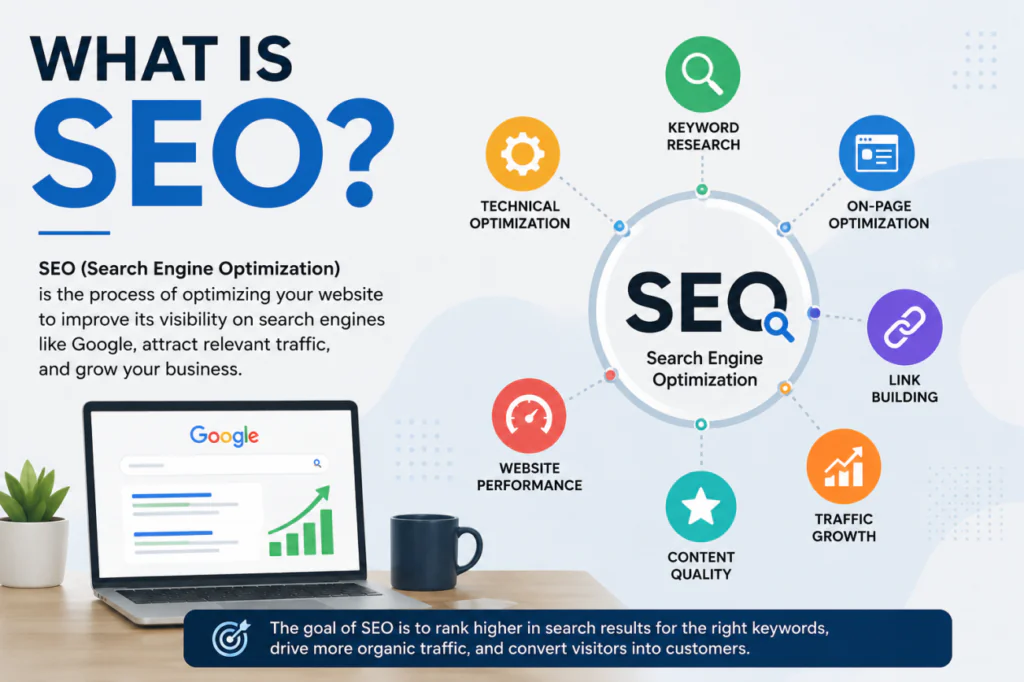
Millions of people use Google every day to find products, services, and information. SEO (Search Engine Optimization) helps your website rank higher in organic search results, attract qualified visitors, and drive long-term business growth. It’s a cost-effective digital marketing strategy that delivers sustainable traffic and high ROI for businesses of all sizes.
What is SEO?
Search Engine Optimization (SEO) is the process of improving a website’s visibility in search engines like Google to attract more organic (non-paid) traffic. By optimizing content, technical performance, and website structure, SEO helps businesses reach the right audience, increase credibility, and generate long-term leads without relying solely on paid advertising.
Definition
SEO (Search Engine Optimization) is the practice of optimizing a website to improve its rankings in search engine results pages (SERPs). It involves creating valuable content, targeting relevant keywords, improving website speed and usability, earning quality backlinks, and ensuring search engines can efficiently crawl and index your pages.
Example:
If you own a manufacturing company that produces industrial valves, optimizing your website for keywords like “industrial valve manufacturer” or “stainless steel valve supplier” can help your business appear when engineers or procurement managers search for those products online.
Organic Search
Organic search refers to the unpaid results displayed on search engine results pages (SERPs). These rankings are earned through high-quality content, relevance, website authority, and technical SEO rather than paid advertising, helping businesses attract qualified traffic naturally.
Search Engines
Search engines are online platforms that help users find information on the internet. They continuously scan billions of web pages, organize the information, and display the most relevant results based on a user’s search query.
Popular search engines include:
- Microsoft Bing
- Yahoo
- DuckDuckGo
- Baidu (China)
- Yandex (Russia)
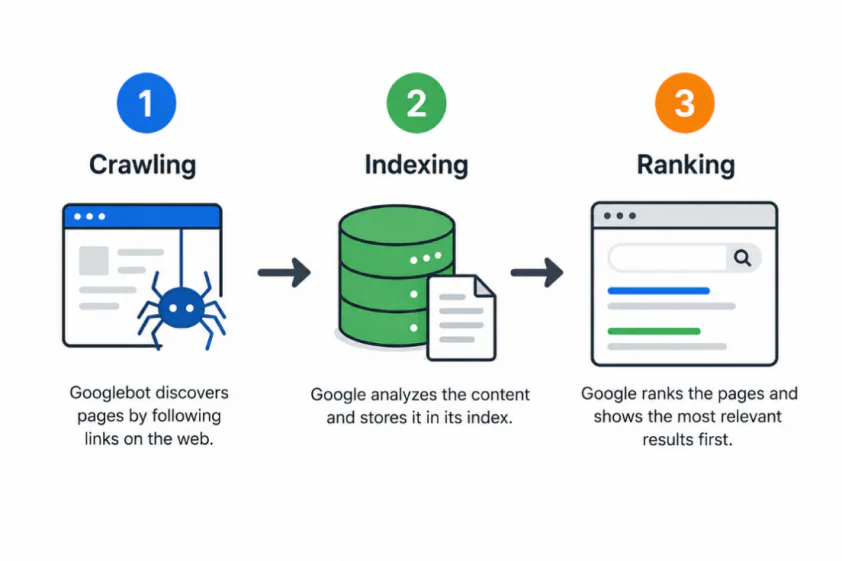
Search engines work through three primary processes:
- Crawling – Discovering web pages using automated bots.
- Indexing – Storing and organizing discovered content.
- Ranking – Displaying the most relevant pages for a user’s search query.
SERP (Search Engine Results Page)
A Search Engine Results Page (SERP) is the page displayed after a user enters a search query into a search engine. Modern SERPs contain much more than traditional blue links and often include various enhanced search features.
A typical SERP may include:
- Organic search results
- Paid advertisements
- AI-generated summaries (where available)
- Featured snippets
- Local Map Pack
- People Also Ask (PAA)
- Images
- Videos
- FAQs
- Knowledge Panels
User Intent
User intent, also known as search intent, is the primary reason behind a user’s search query. Understanding what users want helps businesses create content that directly answers their questions or fulfills their needs.
The four main types of user intent are:
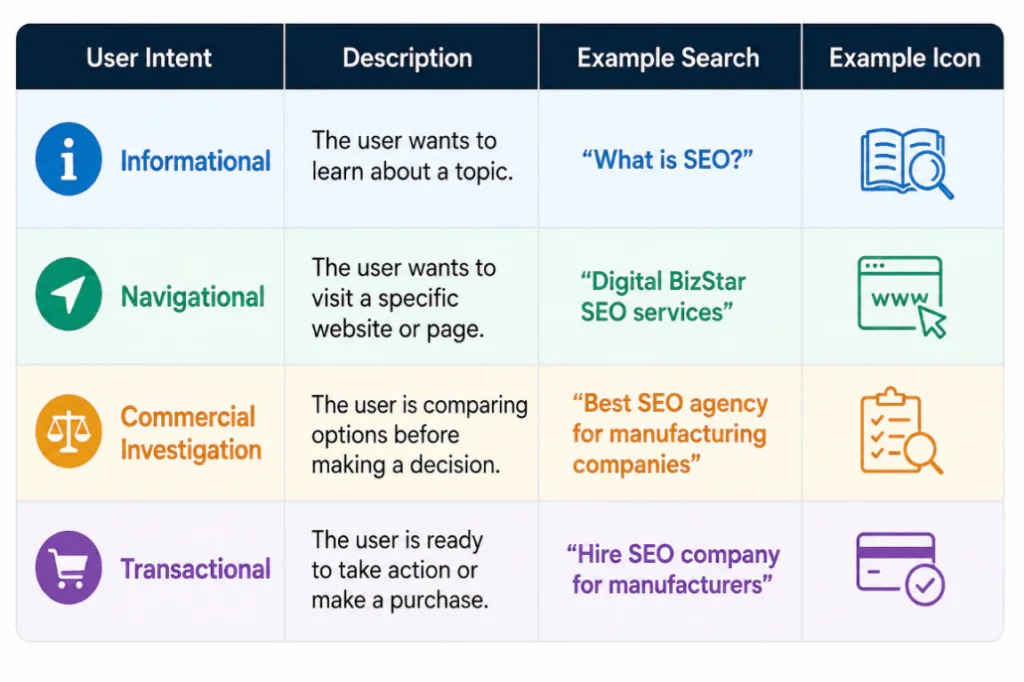
Creating content that aligns with user intent is one of the most important ranking factors.
Why SEO Matters
In today’s digital world, most customers begin their buying journey with a search engine. If your business isn’t visible when people search for your products or services, you’re missing valuable opportunities. SEO helps businesses increase online visibility, attract the right audience, and achieve sustainable growth without relying solely on paid advertising.
Brand Visibility
SEO improves your website’s rankings on search engines, making it easier for potential customers to discover your business. Higher visibility increases brand awareness and keeps your company ahead of competitors.
Qualified Traffic
SEO targets users who are actively searching for your products or services. This brings highly relevant visitors to your website, increasing the chances of generating quality leads and sales.
Higher Trust
Websites that rank higher in search results are often seen as more credible and trustworthy. Quality content, secure browsing (HTTPS), and a well-optimized website help build customer confidence.
Better Conversions
SEO attracts users with clear search intent, making them more likely to take action—whether it’s filling out a contact form, requesting a quote, or making a purchase.
Long-Term ROI
Unlike paid advertising, SEO continues to generate organic traffic over time. A well-optimized website can deliver consistent results and long-term returns with ongoing maintenance.
Lower Customer Acquisition Cost
Since organic traffic doesn’t require payment for every click, SEO helps reduce customer acquisition costs while delivering a steady flow of potential customers.
Competitive Advantage
Businesses that invest in SEO gain a stronger online presence, attract more qualified visitors, and stay ahead of competitors who are less visible in search results.
How Search Engines Work
Search engines like Google use automated systems to discover, understand, and organize billions of web pages before displaying the most relevant results for a user’s search. This process happens in three key stages: Crawling, Indexing, and Ranking.
1. Crawling
Crawling is the process where search engines discover new and updated web pages. Google uses automated bots called Googlebot to scan websites by following links from one page to another and reading XML sitemaps.
If your website has proper internal linking and a sitemap, Googlebot can find and crawl your pages more efficiently.
2. Indexing
After crawling a page, Google analyzes its content and stores it in its massive database, known as the Google Index. During indexing, Google evaluates elements such as the page title, headings, keywords, images, meta description, and overall content to understand what the page is about.
Only indexed pages are eligible to appear in search results.
3. Ranking
When a user performs a search, Google searches its index and ranks the most relevant pages based on hundreds of ranking factors. These include content quality, search intent, backlinks, page speed, mobile-friendliness, user experience, website authority, and many other signals.
The pages that best match the user’s query appear higher in the Search Engine Results Page (SERP).
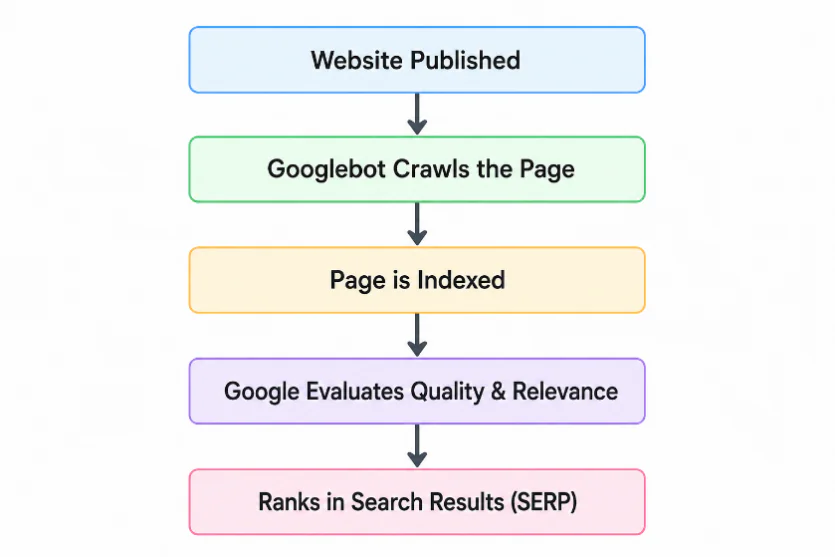
Work flow :
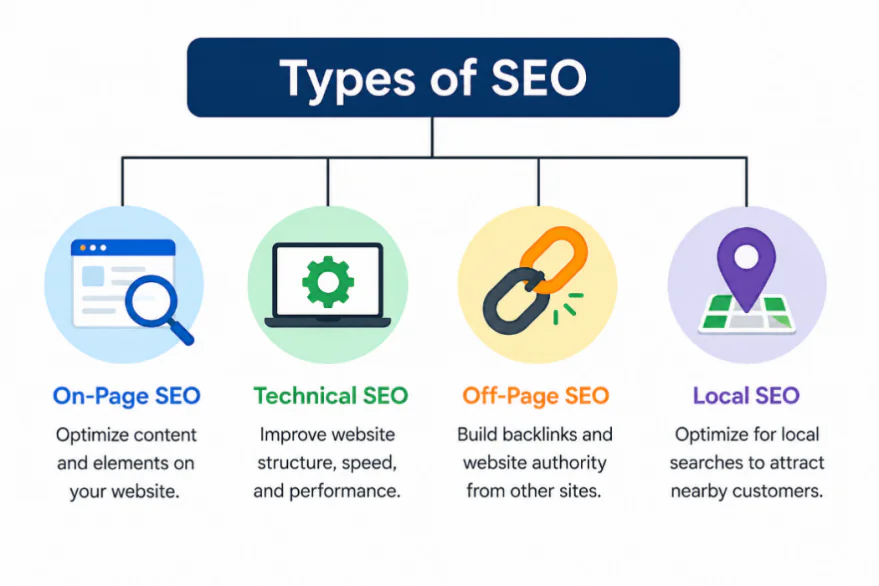
Types of SEO:
On Page SEO:
On-page SEO refers to optimizing the elements within your website to improve search engine rankings and provide a better user experience.
| Element | Description |
| Keywords | Use relevant search terms naturally in titles, headings, content, and URLs. |
| Content | Create high-quality, informative, and original content that matches user search intent. |
| Headings | Organize content using H1, H2, H3, etc., to improve readability and help search engines understand the page structure. |
| Images | Optimize images with descriptive file names, alt text, proper sizes, and compression for faster loading. |
| Internal Links | Link to relevant pages within your website to improve navigation and distribute SEO value. |
| URLs | Keep URLs short, descriptive, keyword-rich, and easy to read. |
| Meta Tags | Write compelling SEO titles and meta descriptions to improve search visibility and click-through rates. |
Technical SEO
Technical SEO focuses on optimizing your website’s technical aspects so search engines can crawl, index, and rank your pages efficiently.
| Element | Description |
| Core Web Vitals | Measures page speed, interactivity, and visual stability to improve user experience. |
| Mobile Friendly | Ensures your website works well on smartphones and tablets. |
| HTTPS | Secures your website with SSL encryption, protecting user data and improving trust. |
| XML Sitemap | A file that lists your website’s pages to help search engines discover and index them. |
| Robots.txt | Tells search engine crawlers which pages or folders they can or cannot access. |
| Canonical Tags | Prevent duplicate content by telling search engines which page is the preferred version. |
| Structured Data | Adds schema markup so search engines better understand your content and can display rich results. |
| Crawl Budget | The number of pages a search engine crawls on your site within a given period. Optimize it by removing unnecessary pages. |
| Broken Links | Links that lead to missing pages (404 errors). Fix them to improve user experience and SEO. |
| Redirects | Automatically send users and search engines from one URL to another (e.g., 301 permanent redirects). |
Off-Page SEO
Off-page SEO focuses on activities outside your website that improve your authority, credibility, and search engine rankings.
| Element | Description |
| Backlinks | Earn high-quality links from other websites to increase your site’s authority. |
| Digital PR | Gain online media coverage and mentions through news, press releases, and industry publications. |
| Guest Posting | Publish valuable content on relevant websites to build backlinks and reach new audiences. |
| Brand Mentions | Increase your brand’s visibility through online mentions, even if they don’t always include a link. |
| Local Citations | List your business on trusted local directories to improve local SEO and credibility. |
| Social Signals | Promote content on social media to increase visibility, engagement, and potential backlinks. While social signals aren’t a direct ranking factor, they can support SEO indirectly. |
Local SEO
Local SEO helps businesses appear in local search results and attract customers from a specific geographic area.
| Element | Description |
| Google Business Profile | Create and optimize your Google Business Profile to appear in Google Search and Google Maps. |
| Reviews | Encourage positive customer reviews to build trust and improve local rankings. |
| NAP Consistency | Keep your Name, Address, and Phone Number (NAP) consistent across your website and all online directories. |
| Local Citations | List your business on trusted online directories and local websites to increase visibility and credibility. |
| Maps Rankings | Optimize your local presence to improve rankings in Google Maps and the local search results. |
Keyword Research
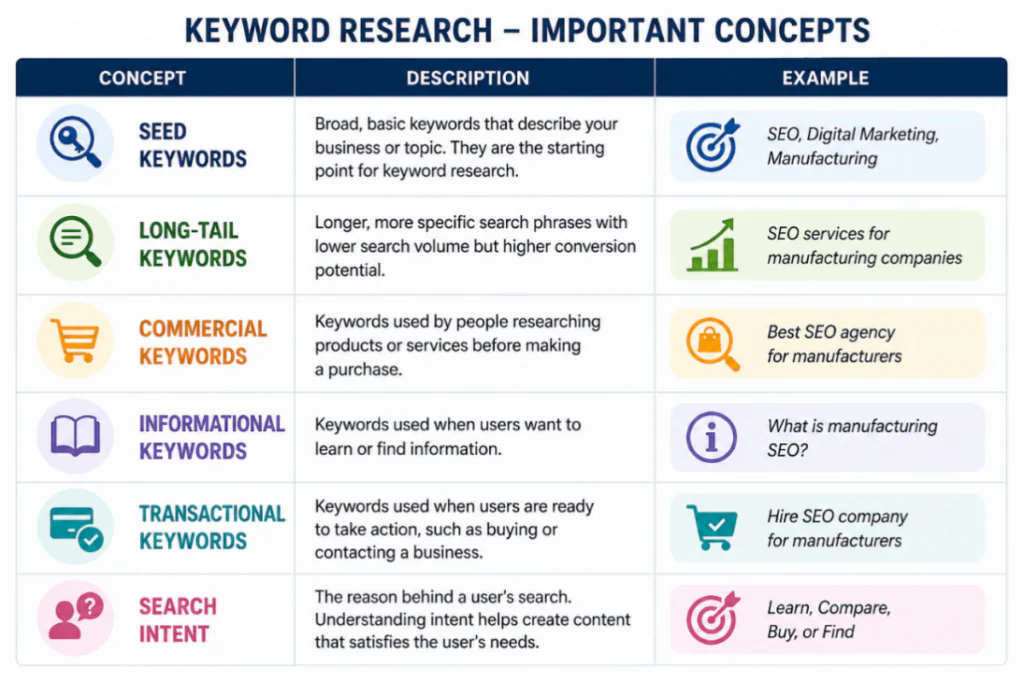
Keyword research is the process of finding the words and phrases people use in search engines. It helps you create content that matches what your audience is searching for.
Popular Keyword Research Tools
Choosing the right keyword research tool helps you discover what your audience is searching for, analyze competition, and identify opportunities to improve your SEO strategy.
Google Keyword Planner
Google Keyword Planner is a free tool from Google that helps you discover keyword ideas, search volume, competition levels, and keyword trends. It is ideal for finding relevant keywords for both SEO and Google Ads.
Best for: Keyword ideas, search volume, and competition analysis.
Google Trends
Google Trends shows how search interest for a keyword changes over time. It helps identify seasonal trends, compare multiple keywords, and discover trending topics across different regions.
Ahrefs
Ahrefs is a comprehensive SEO platform that provides keyword research, backlink analysis, competitor research, content gap analysis, and website audits. It helps businesses identify high-value keywords and understand why competitors rank well.
SEMrush
SEMrush is an all-in-one digital marketing platform that offers keyword research, competitor analysis, rank tracking, site audits, backlink analysis, and content optimization. It helps businesses develop data-driven SEO strategies and monitor their search performance.
Search Intent
Search intent refers to the purpose behind a user’s search query. Understanding search intent helps you create content that matches what users are looking for, improving both rankings and conversions.
Informational Intent
Users want to learn about a topic or find answers to a question. They are looking for educational content rather than making an immediate purchase.
Navigational Intent
Users already know the website or brand they want to visit and use a search engine to find it quickly.
Commercial Investigation Intent
Users are researching and comparing products or services before making a purchase. They are evaluating the best options available.
Transactional Intent
Users are ready to take action, such as purchasing a product, booking a service, or requesting a quote.
Key Takeaway: Matching your content to the right search intent helps attract the right audience, improve rankings, and increase conversions.
Content SEO
How to Write Content Google Actually Ranks
Creating content that ranks on Google is no longer about adding keywords repeatedly. Google rewards content that is helpful, relevant, trustworthy, and provides real value to users. By following SEO best practices, you can improve your chances of ranking higher and attracting qualified organic traffic.
Helpful Content
Create original, user-focused content that answers search queries clearly and completely. Focus on solving problems instead of writing only for search engines.
E-E-A-T
E-E-A-T stands for Experience, Expertise, Authoritativeness, and Trustworthiness. Google favors content created by experienced professionals, supported by accurate information, and published on trustworthy websites.
Tip: Include author details, case studies, testimonials, and credible references to build trust.
Freshness
Regularly update your content with the latest statistics, trends, examples, and best practices. Fresh content is more likely to remain relevant and competitive in search results.
Topical Authority
Build multiple high-quality articles around a specific topic to demonstrate expertise. Covering related subtopics helps Google understand your website as an authority in that niche.
Readability
Write content that is easy to read and understand. Use short paragraphs, descriptive headings, bullet points, images, and simple language to improve the user experience.
Tip: Make your content easy to scan so readers can quickly find the information they need.
Link related pages and blog posts within your website. Internal links help users discover more content and allow search engines to crawl and understand your website structure.
Internal Linking
FAQs
Include a Frequently Asked Questions (FAQ) section to answer common user queries. FAQs improve user experience, target long-tail keywords, and may help your content appear in rich search results.
Example FAQs:
- What is SEO?
- How long does SEO take?
- Is SEO better than Google Ads?
- How often should I update my website?
Technical SEO Checklist
✅ HTTPS Enabled – Secure your website with an SSL certificate.
✅ Mobile-Friendly Design – Ensure your website works seamlessly on all devices.
✅ XML Sitemap – Submit an XML sitemap to help search engines discover your pages.
✅ Robots.txt Configured – Guide search engine crawlers on which pages to crawl or block.
✅ Schema Markup – Add structured data to improve search result visibility with rich snippets.
✅ Fast Loading Speed – Optimize images, code, and server performance for quicker page loads.
✅ Core Web Vitals Optimized – Improve LCP, INP, and CLS for a better user experience.
✅ Canonical Tags – Prevent duplicate content by specifying the preferred page version.
✅ Crawl Errors Fixed – Regularly monitor and resolve crawl issues in Google Search Console.
✅ Broken Links Removed – Find and fix broken internal and external links to improve user experience and SEO.
Image SEO
Image SEO is the process of optimizing images so search engines can understand them and display them in search results. Proper image optimization improves page speed, user experience, and organic visibility.
Alt Text
Alt text (alternative text) describes an image for search engines and screen readers. It improves accessibility and helps images rank in Google Images.
File Name
Use descriptive, keyword-rich file names instead of generic names like IMG001.jpg.
Compression
Compress images to reduce file size without significantly affecting quality. Smaller images load faster and improve website performance.
Best Practice: Use image compression tools before uploading images.
WebP
Use the WebP image format instead of PNG or JPEG whenever possible. WebP provides high-quality images with smaller file sizes, improving page speed.
Lazy Loading
Lazy loading delays image loading until users scroll near them. This reduces initial page load time and improves Core Web Vitals.
Benefit: Faster website loading and better user experience.
Image Sitemap
An image sitemap helps search engines discover and index all images on your website, increasing the chances of appearing in Google Image Search.
Benefit: Better image indexing and improved organic visibility.
Common Types of Schema Markup
Schema markup is structured data added to your website that helps search engines understand your content. It can improve your visibility in search results by enabling rich snippets such as ratings, FAQs, product details, and breadcrumbs.
Organization Schema
Organization schema provides information about your company, such as its name, logo, website, contact details, and social media profiles. It helps search engines identify your business and improve brand recognition.
Local Business Schema
Local Business schema provides location-specific information, including your business name, address, phone number, business hours, and geographic coordinates. It improves visibility in local search results and Google Maps.
Product Schema
Product schema displays detailed product information such as price, availability, ratings, reviews, SKU, and product images directly in search results, helping improve click-through rates.
FAQ Schema
FAQ schema highlights frequently asked questions and answers directly in search results, making your listing more informative and improving user engagement.
Best for: Service pages, blog posts, and help center articles.
Article Schema
Article schema helps search engines understand blog posts, news articles, and guides by providing details like the headline, author, publication date, featured image, and publisher.
Breadcrumb Schema
Breadcrumb schema displays your website’s navigation path (breadcrumb trail) in search results, helping users understand the page hierarchy and navigate your website more easily.
Review Schema
Review schema displays star ratings, customer reviews, and review counts in search results. Rich review snippets can improve credibility and encourage more clicks.
Benefits of Schema Markup
Adding schema markup helps search engines better understand your website’s content, making it eligible for enhanced search features that can improve visibility and user engagement.
Rich Results
Schema markup enables your pages to appear as rich results in Google Search. These enhanced listings can display additional information such as star ratings, FAQs, product prices, availability, breadcrumbs, and business details, making your listing more attractive.
Higher Click-Through Rate (CTR)
Rich results stand out compared to standard search listings, making users more likely to click on your page. A higher CTR can increase organic traffic and improve your website’s overall search performance.
Core Web Vitals
Core Web Vitals are Google’s key performance metrics that measure a website’s loading speed, responsiveness, and visual stability. Good Core Web Vitals improve user experience and can positively impact search rankings.
| Metric | Measures | Good Score |
| LCP | Loading performance | ≤ 2.5 seconds |
| INP | Page responsiveness | ≤ 200 ms |
| CLS | Visual stability | ≤ 0.1 |
How to Improve LCP:
- Compress and optimize images.
- Use the WebP image format.
- Enable browser caching.
- Improve server response time.
- Minify CSS and JavaScript.
How to Improve INP:
- Reduce JavaScript execution time.
- Remove unnecessary scripts.
- Optimize third-party plugins.
- Break up long tasks.
- Improve browser responsiveness.
How to Improve CLS:
- Specify width and height for images and videos.
- Reserve space for ads and embedded content.
- Avoid inserting content above existing elements.
- Use stable fonts to prevent layout shifts.
Mobile SEO
Mobile SEO is the process of optimizing your website to provide a fast, user-friendly experience on smartphones and tablets. Since Google uses mobile-first indexing, having a mobile-optimized website is essential for better rankings and user engagement.
Responsive Design
A responsive website automatically adjusts its layout and content to fit different screen sizes, providing a consistent experience across desktops, tablets, and mobile devices.
Touch-Friendly UI
Design your website with mobile users in mind by using large buttons, readable fonts, and adequate spacing between clickable elements. This makes navigation easier and reduces accidental clicks.
Page Speed
Fast-loading mobile pages improve user satisfaction and reduce bounce rates. Optimize images, minimize code, enable browser caching, and use modern formats like WebP to improve loading speed.
Mobile-First Indexing
Google primarily uses the mobile version of your website for crawling, indexing, and ranking. Ensure that your mobile site contains the same content, metadata, and structured data as your desktop version.
Voice Search SEO
Voice Search SEO is the process of optimizing your website for voice-based searches made through devices like Google Assistant, Siri, Alexa, and other smart assistants. Voice searches are usually longer and more conversational than typed queries.
Conversational Keywords
Use natural, question-based keywords that match how people speak rather than type.
FAQs
Create FAQ sections that answer common customer questions clearly and concisely. Voice assistants often pull answers directly from well-structured FAQ content.
Featured Snippets
Structure your content with headings, bullet points, numbered lists, and concise answers to increase the likelihood of earning Google’s featured snippets, which are frequently used for voice search responses.
Benefit: Increases visibility and drives more organic traffic.
Local Optimization
Optimize your Google Business Profile, maintain consistent business information (NAP), and include location-based keywords to improve visibility for local voice searches.
AI Search & SEO (2026)
Search is evolving with AI-powered experiences like AI Overviews and conversational search assistants. While traditional search results remain important, businesses now need content that is accurate, well-structured, and trustworthy to increase their visibility in AI-generated answers.
AI Overviews & AI-Assisted Search
AI-powered search engines summarize information from multiple trusted sources to provide quick answers. Websites with clear, high-quality content are more likely to be referenced in these AI-generated responses.
Answer Engine Optimization (AEO)
Answer Engine Optimization (AEO) focuses on creating content that answers specific questions clearly and concisely, making it easier for AI search engines and virtual assistants to understand and present your information.
Structured & Authoritative Content
Organize your content with clear headings, logical sections, bullet points, tables, and schema markup. Cover topics in depth to establish your website as a trusted source of information.
E-E-A-T & Citations
Google values Experience, Expertise, Authoritativeness, and Trustworthiness (E-E-A-T). Support your content with credible sources, expert insights, case studies, and accurate information to build trust with both search engines and users.
Why Traditional SEO Still Matters
AI search relies on content that has already been crawled, indexed, and evaluated by search engines. Strong technical SEO, high-quality content, keyword optimization, backlinks, and a great user experience remain the foundation for achieving visibility in both traditional and AI-powered search.
Common SEO Mistakes
Avoid these common SEO mistakes, as they can negatively impact your search rankings, user experience, and organic traffic:
- Keyword Stuffing – Overusing keywords unnaturally throughout your content.
- Duplicate Content – Publishing the same or very similar content across multiple pages.
- Thin Pages – Creating pages with little or no valuable information.
- Poor Internal Linking – Failing to connect related pages, making navigation and crawling difficult.
- Broken Links – Leaving internal or external links that lead to non-existent pages.
- Ignoring Mobile Optimization – Having a website that doesn’t perform well on mobile devices.
- Missing Schema Markup – Not using structured data to help search engines understand your content.
- Slow Website Speed – Poor page loading times that reduce user experience and rankings.
- Buying Backlinks – Acquiring low-quality or spammy backlinks that violate search engine guidelines.
- Ignoring Search Intent – Creating content that doesn’t match what users are actually searching for.
SEO Tools
| Tool | Purpose | Best For |
| Google Search Console | Monitors website performance, indexing, and search visibility. | Performance tracking, indexing, technical SEO |
| Google Analytics 4 (GA4) | Tracks website traffic, user behavior, and conversions. | Traffic analysis and user insights |
| Ahrefs | Provides keyword research, backlink analysis, competitor research, and site audits. | SEO research and backlink analysis |
| SEMrush | All-in-one SEO platform for keyword research, competitor analysis, rank tracking, and technical audits. | Complete SEO management |
| Screaming Frog SEO Spider | Crawls websites to identify technical SEO issues such as broken links, duplicate content, and redirects. | Technical SEO audits |
| Yoast SEO | WordPress plugin for optimizing on-page SEO, metadata, XML sitemaps, and readability. | On-page SEO for WordPress |
| Google PageSpeed Insights | Analyzes website speed and Core Web Vitals with optimization recommendations. | Page speed optimization |
| Google Keyword Planner | Finds keyword ideas, search volume, and competition data. | Keyword research |
| Google Trends | Shows keyword popularity and search trends over time. | Trend and seasonal keyword analysis |
| Looker Studio | Creates interactive SEO dashboards by combining data from multiple sources. | SEO reporting and data visualization |
SEO Metrics to Track
· Organic Traffic – Measure the number of visitors coming to your website through unpaid search results.
· Keyword Rankings – Track how your target keywords perform in search engine results over time.
· Click-Through Rate (CTR) – Monitor the percentage of users who click your website after seeing it in search results.
· Bounce Rate – Analyze how many visitors leave your website without interacting with another page.
· Conversions – Measure the number of visitors who complete desired actions, such as purchases, form submissions, or quote requests.
· Core Web Vitals – Monitor loading speed, responsiveness, and visual stability to ensure an excellent user experience.
· Backlinks – Track the quantity and quality of backlinks pointing to your website to evaluate authority.
· Indexed Pages – Ensure important pages are successfully indexed and eligible to appear in search results.
· Domain Authority – Measure your website’s overall credibility and ability to compete for higher rankings (third-party metric).
· Leads Generated – Evaluate how effectively your SEO efforts generate qualified business inquiries and customers.
Common SEO Myths
- ❌ SEO Is Dead – SEO continues to evolve and remains one of the most effective long-term digital marketing strategies.
- ❌ More Keywords = Better Rankings – Keyword stuffing hurts SEO. Focus on creating natural, high-quality, user-focused content.
- ❌ Backlinks Don’t Matter – Quality backlinks are still a major ranking factor that helps build authority and trust.
- ❌ AI Replaces SEO – AI enhances SEO, but it cannot replace technical optimization, strategy, and valuable human-created content.
- ❌ SEO Works Overnight – SEO is a long-term process that typically takes several months to produce consistent results.
- ❌ Meta Keywords Help Rankings – Modern search engines like Google do not use the meta keywords tag as a ranking factor.
SEO Trends for 2026
- AI Search – Optimize content for AI-powered search experiences and AI-generated overviews.
- Entity SEO – Build content around entities (people, places, brands, concepts) to improve contextual relevance.
- Topic Clusters – Organize related content around pillar pages to strengthen topical coverage and internal linking.
- Helpful Content – Create original, user-focused content that genuinely solves searchers’ problems.
- Topical Authority – Publish comprehensive content across a subject to establish expertise and trust.
- Video SEO – Optimize videos with titles, descriptions, transcripts, and structured data to increase visibility.
- Voice Search – Target conversational, long-tail keywords and question-based queries for voice assistants.
- E-E-A-T – Demonstrate Experience, Expertise, Authoritativeness, and Trustworthiness through credible content.
- User Experience (UX) – Improve page speed, mobile usability, navigation, and Core Web Vitals to enhance engagement.
- Structured Data – Implement schema markup to help search engines understand your content and qualify for rich results.
SEO Checklist
�� Daily
- ✅ Monitor organic traffic
- ✅ Check keyword rankings
- ✅ Review Google Search Console errors
- ✅ Monitor website uptime
- ✅ Respond to customer reviews
�� Weekly
- ✅ Publish new content
- ✅ Update existing content
- ✅ Check broken links
- ✅ Review backlinks
- ✅ Analyze competitor rankings
�� Monthly
- ✅ Perform a technical SEO audit
- ✅ Improve page speed
- ✅ Review Core Web Vitals
- ✅ Update XML sitemap
- ✅ Optimize underperforming pages
�� Quarterly
- ✅ Conduct a content audit
- ✅ Refresh topic clusters
- ✅ Review backlink profile
- ✅ Update schema markup
- ✅ Analyze SEO performance
�� Yearly
- ✅ Perform a complete website SEO audit
- ✅ Update SEO strategy
- ✅ Refresh evergreen content
- ✅ Review target keywords
- ✅ Set new SEO goals and KPIs
Frequently Asked Questions
Add FAQs like:
- What is SEO?
- How long does SEO take?
- Is SEO better than Google Ads?
- Does SEO still work in 2026?
- How much does SEO cost?
Why Choose Digital BizStar for SEO?
Digital BizStar delivers data-driven, business-focused SEO strategies engineered to increase search visibility, attract high-intent traffic, and generate qualified leads. We combine technical SEO, semantic content optimization, topical authority, entity SEO, AI search optimization, structured data, and conversion-focused on-page optimization to build sustainable organic growth.
Our SEO framework goes beyond keyword rankings by optimizing site architecture, crawl efficiency, Core Web Vitals, indexability, internal linking, E-E-A-T signals, and authority acquisition. Every campaign is backed by in-depth competitor analysis, search intent mapping, performance analytics, and continuous optimization to maximize ROI and deliver measurable business outcomes.
Conclusion
SEO is a long-term growth strategy that combines technical excellence, high-quality content, topical authority, structured data, and continuous optimization to improve search visibility and attract qualified traffic. By adapting to evolving search algorithms and AI-powered search, businesses can achieve sustainable rankings, higher conversions, and lasting competitive advantage.