 +91 7550360374
  info@digitalbizstar.com
Food Delivery Service SEO Agency
The global online food delivery market is expected to exceed $1.8 trillion by 2032, making competition for online visibility tougher than ever. Whether you’re a local food delivery startup, cloud kitchen, grocery delivery service, or restaurant offering home delivery, ranking on Google can significantly increase online orders. This is where a specialized Food Delivery Service SEO Agency can help your business attract high-intent customers and drive sustainable growth.
Who Can Benefit from Food Delivery SEO?
Food delivery SEO isn’t limited to restaurants alone. Any business that relies on online orders and local search visibility can benefit from a well-planned SEO strategy. Whether you’re serving a single neighborhood or operating across multiple cities, the right SEO approach helps attract high-intent customers and increase online orders.
- Food Delivery Apps
- Cloud Kitchens
- Restaurant Chains
- Grocery Delivery Services
- Meal Kit Companies
- Franchise Restaurants
- Healthy Meal Delivery
- Local Delivery Startups
Why Food Delivery Businesses Need Specialized SEO
Delivery is a hyper-local, high-intent business. People searching for delivery options are usually ready to order within minutes, not researching for weeks. That changes the SEO playbook in a few important ways:
- Local intent dominates. Searches like “delivery near me” or “[city] food delivery” trigger Google’s local pack, and ranking there depends heavily on Google Business Profile optimization, reviews, and location-specific landing pages — not just blog content.
- Speed and mobile experience matter more. Most delivery searches happen on mobile, often while someone is already hungry. A slow-loading menu page can cost you the order before a competitor even finishes loading.
- Multi-location and franchise complexity. Chains and franchises need scalable SEO — city and neighborhood pages, structured data for menus and service areas, and consistent NAP (name, address, phone) data across dozens or hundreds of locations.
- The competitive set is unusual. You’re not just competing with other delivery services; you’re competing with aggregator marketplaces (which often outrank individual restaurants for their own brand terms) and directory sites.
A generalist agency can miss all of this. A food delivery service SEO agency builds strategy around these realities from day one.
Benefits of Hiring a Food Delivery Service SEO Agency
Discuss:
- More online orders
- Lower customer acquisition cost
- Increased local visibility
- Better Google Maps rankings
- Improved mobile conversions
- Long-term organic growth
- Higher ROI than paid ads
Statistics
Include credible industry data, for example:
- 46% of Google searches have local intent.
- Over 60% of food delivery orders are placed via mobile devices.
- Businesses appearing in Google’s Local Pack receive significantly higher click-through rates than standard organic listings.
Core Services a Food Delivery Service SEO Agency Should Offer
1. Technical SEO and Site Health
Before any content or link work matters, your site needs to be crawlable and fast. This typically includes fixing broken links and duplicate content, cleaning up site architecture, improving page speed, and implementing structured data (schema markup) for menus, reviews, business hours, and service areas so Google — and increasingly AI-powered search tools — can understand your site at a glance.
2. Local SEO and Google Business Profile Management
For any delivery business, local visibility is often the single biggest revenue driver. This means optimizing and actively managing your Google Business Profile, building location-specific landing pages for each service area, keeping business listings consistent across directories, and building a review-generation process, since ratings and review volume directly influence local rankings and click-through rates.
3. Keyword Research and Content Strategy
Effective delivery SEO targets intent-based keywords across the buying journey — from broad terms like “food delivery service” to hyper-specific ones like “vegan meal delivery [neighborhood].” Content typically includes optimized service and location pages, blog content that captures informational searches, and comparison or “best of” style content that captures customers still deciding between options.
4. Link Building and Authority Growth
Backlinks from relevant, reputable sites remain one of the strongest ranking signals. Agencies pursue this through outreach to food, lifestyle, and local publications; guest content; digital PR; and partnerships that earn editorial mentions rather than relying on low-quality, spammy link sources that can trigger penalties.
5. PPC and SEO Integration
Many agencies pair organic SEO with paid search and local service ads, since food delivery is a category where paid and organic results often appear side by side. Coordinating both channels — shared keyword data, consistent landing pages, and unified reporting — tends to outperform running them separately.
6. AI Search and Generative Engine Optimization (GEO)
As more consumers ask ChatGPT, Perplexity, or Google’s AI Overviews for delivery recommendations, agencies are increasingly building content structured to be cited by AI systems — clear Q&A formatted pages, strong entity signals, and schema markup that helps AI engines understand and recommend your brand alongside traditional Google rankings.
Comparing Generic SEO Agency & Food Delivery SEO Agency
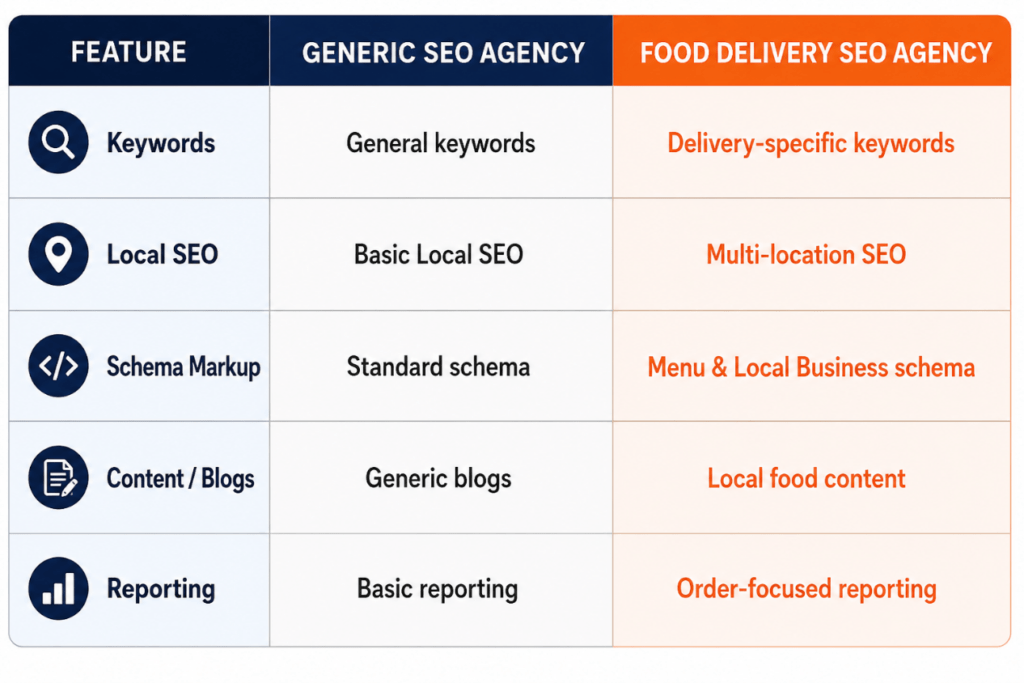
What Separates a Strong Agency From a Mediocre One
When evaluating a food delivery service SEO agency, a few signals matter more than flashy pitch decks:
- Industry-specific case studies. Ask for real examples of delivery, restaurant, or local-service clients — not just generic traffic graphs.
- Transparent reporting. You should be able to see exactly what content was published, which backlinks were earned, and how rankings and traffic are trending, on a regular cadence.
- Human oversight of content. AI tools can speed up research and drafting, but content that’s purely machine-generated tends to underperform and can hurt trust signals. Look for agencies where humans edit, fact-check, and approve everything before it publishes.
- Local SEO expertise, not just national SEO. Delivery businesses live and die by local pack visibility, so this should be a core specialty, not an afterthought.
- Clear, predictable pricing. Retainers in this space vary widely — from a few hundred dollars a month for smaller, human-led programs up to several thousand for full-service agencies handling SEO, PPC, web design, and social media together. Make sure you understand exactly what’s included before signing anything.
- A plan for both Google and AI search. As search behavior shifts, an agency that only optimizes for classic Google rankings is already behind.
Common Mistakes Food Delivery Brands Make With SEO
- Ignoring location pages. A single generic homepage can’t rank for every city or neighborhood you serve.
- Neglecting reviews. Review quantity and recency are ranking factors, not just trust signals.
- Duplicate menus across locations. Copy-pasted menu content across multiple location pages creates duplicate content issues that suppress rankings.
- Underinvesting in page speed. Hungry customers won’t wait for a slow menu page to load — and neither will Google’s rankings favor it.
- Treating SEO as a one-time project. Rankings compound over months, not weeks. Consistent publishing, link building, and technical maintenance matter more than a single audit.
Frequently Asked Questions
Can SEO increase online food orders?
Yes. SEO helps your food delivery business appear in front of customers actively searching for delivery services, increasing qualified website traffic and direct online orders. Unlike paid advertising, SEO provides long-term visibility and sustainable growth while reducing customer acquisition costs.
Is SEO better than Google Ads for food delivery?
SEO and Google Ads work best together. Google Ads deliver immediate traffic and orders, while SEO builds long-term organic visibility and sustainable growth. Investing in both strategies helps maximize online orders and achieve a better return on marketing investment.
How do AI search engines impact food delivery SEO?
AI-powered search platforms like Google AI Overviews, ChatGPT, Gemini, and Perplexity are changing how customers find food delivery services. Optimizing your website with quality content, structured data, FAQs, and strong local SEO improves your chances of being recommended by both traditional search engines and AI-driven search experiences.
How do I rank my food delivery app on Google?
To rank your food delivery app on Google, optimize your website with relevant keywords, create location-specific landing pages, improve website speed, optimize your Google Business Profile, implement structured data, and publish high-quality content. Combining SEO with App Store Optimization (ASO) further improves visibility and app downloads.
How much does a food delivery service SEO agency cost? Pricing varies significantly based on scope. Smaller, human-led content and link-building programs can start in the few-hundred-dollars-per-month range, while full-service agencies offering SEO, PPC, web design, and social media together often run into the thousands per month, especially for multi-location or franchise brands.
Conclusion
Success in the food delivery industry depends on being visible where customers search first. A specialized Food Delivery Service SEO Agency helps your business improve local rankings, attract high-intent customers, optimize for AI-driven search, and increase online orders through a combination of technical SEO, local optimization, content marketing, and authority building. If you’re ready to grow your delivery business, Digital BizStar can create a customized SEO strategy designed to generate long-term traffic, qualified leads, and measurable ROI.