 +91 7550360374
  info@digitalbizstar.com
SaaS marketing is the set of strategies — SEO and content, product-led growth, paid acquisition, ABM, lifecycle email, and retention programs — used to acquire, activate, and expand subscription software customers over time. Unlike traditional marketing, it never really “ends” at the sale; the real work starts after signup, because recurring revenue depends on usage, renewal, and expansion, not just a one-time close.

Key takeaways
- SaaS marketing covers the entire customer lifecycle — acquisition, activation, retention, and expansion — not just top-of-funnel lead generation.
- The best SaaS go-to-market motions blend content/SEO, product-led growth (PLG), paid search, LinkedIn/ABM, and lifecycle email around one clear ICP and value proposition.
- Metrics that matter: CAC, LTV:CAC ratio, CAC payback period, MRR/ARR, net revenue retention (NRR), and churn.
- AI search is changing how SaaS companies think about content discovery. Buyers can increasingly encounter companies, products, and recommendations through AI-generated search experiences such as ChatGPT, Perplexity, and Google’s AI features. This means SaaS content needs to be useful not only for traditional search rankings, but also for systems that summarize and synthesize information.
- Many founders and marketing teams eventually bring in a specialist saas marketing agency once in-house bandwidth caps out — more on when that makes sense below.
What Is SaaS Marketing?
SaaS marketing is the practice of promoting cloud-based, subscription software to the people who will buy, use, and eventually renew or expand it. It borrows tactics from B2B marketing generally — SEO, paid ads, email, social — but applies them differently because the business model is different.
In traditional product marketing, the sale is the finish line. In SaaS, the sale is the starting line. A customer who signs up but never logs in, or who churns after month three, is a marketing and product failure just as much as a low-lead-volume month is. That’s why SaaS marketing teams are judged on metrics further down the funnel — activation rate, retention, expansion revenue — not just traffic and MQLs.
How SaaS Marketing Differs From Traditional Marketing
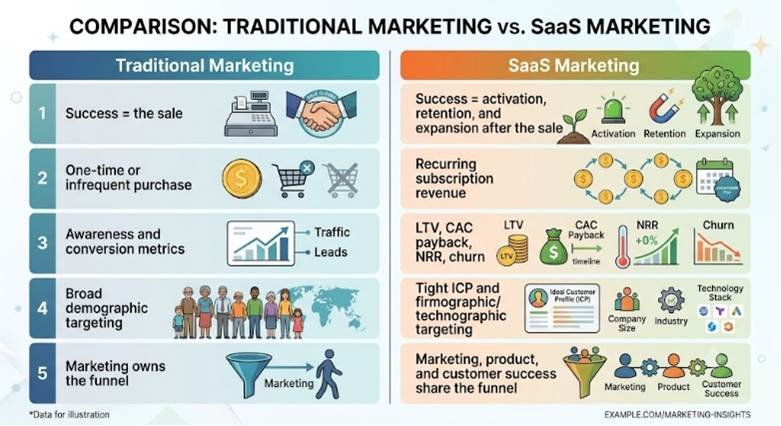
The Foundations: ICP, Positioning, and Value Proposition
Before choosing channels or spending a dollar on ads, every credible SaaS marketing strategy — including the frameworks used by leading saas marketing companies — starts with three foundational pieces:
- Ideal Customer Profile (ICP): Define the company size, industry, tech stack, and buying triggers of accounts most likely to convert and stick around. A tight ICP keeps CAC down and NRR up.
- Positioning: Where do you sit relative to competitors and the status quo? Positioning should be defensible and specific — “the only X for Y” beats generic claims like “all-in-one platform.”
- Value proposition: What outcome does the buyer actually get, in language they use, not internal product jargon?
Get these wrong and no amount of content, paid spend, or agency support will fix the leak. This is also usually the first engagement a saas branding agency or saas creative agency will run before touching a single campaign — messaging and visual identity have to be locked before scaling spend.
The SaaS Marketing Funnel: Acquisition to Expansion
A high-converting SaaS funnel maps to the full customer lifecycle, not just the top:
1. Acquisition
Get the right people to discover you. Core channels: SEO and content marketing, paid search, LinkedIn ads and organic, review platforms (G2, Capterra), partnerships, and PR.
2. Activation
Turn a signup into a user who experiences real value — the “aha moment.” This is where onboarding flows, in-app messaging, and product-qualified lead (PQL) scoring live.
3. Retention
Keep customers engaged and renewing. Lifecycle email, in-app nudges, customer success content, and usage-based alerts all reduce churn here.
4. Expansion
Grow revenue from existing accounts through upsells, cross-sells, and seat expansion — often the cheapest revenue a SaaS company can generate.
5. Advocacy
Turn happy customers into case studies, reviews, and referrals that feed back into acquisition.
Core SaaS Marketing Channels and Strategies
SEO and Content Marketing
Organic search remains the backbone of sustainable SaaS growth because it compounds. Bottom-of-funnel content (comparison pages, “best X software” roundups, use-case pages) tends to convert fastest, while top-of-funnel educational content builds long-term authority and topical relevance.
Product-Led Growth (PLG)
Free trials, freemium tiers, and self-serve onboarding let the product sell itself. PLG funnels typically track activation rate and free-to-paid conversion rather than traditional MQLs.
Paid Acquisition
Google Ads (especially on competitor and category terms) and LinkedIn Ads let you target by job title, company size, and intent. Paid works best once messaging and conversion paths are already validated organically.
Account-Based Marketing (ABM)
For higher-ACV B2B SaaS, ABM orchestrates coordinated outreach across a buying committee — not just a single lead — combining intent data, personalized ads, and sales alignment. This is a core specialty of most b2b saas marketing agency teams because it requires tight sales-marketing coordination most in-house teams don’t have bandwidth to run alone.
Lifecycle and Retention Email
Automated sequences based on user behavior — onboarding drips, feature-adoption nudges, renewal reminders, win-back campaigns — directly protect NRR.
Social Proof and Reviews
G2, Capterra, and Trustpilot reviews influence buyers as much as (sometimes more than) your own website copy. Actively managing review velocity is now a standing workstream for most saas digital marketing programs.
PR and Thought Leadership
Earned media, founder-led LinkedIn content, and category-defining research reports build credibility that paid channels can’t buy. Many companies bring in a dedicated saas pr agency specifically to land trade press, podcast placements, and analyst mentions that compound brand trust over time.
SaaS Marketing Metrics That Actually Matter
Vanity metrics (impressions, raw traffic) are easy to report and easy to misread. Track these instead:
- CAC (Customer Acquisition Cost): The sales and marketing cost required to acquire a new customer.
- LTV:CAC ratio: Compares the expected lifetime value of a customer with the cost of acquiring them.
- CAC payback period: Measures how long it takes to recover customer acquisition costs through gross profit.
- MRR/ARR: Measures recurring subscription revenue on a monthly or annual basis.
- Net Revenue Retention (NRR): Measures how recurring revenue from existing customers changes after expansion, downgrades, and churn.
- Churn rate: Measures the rate at which customers or recurring revenue are lost.
- Activation rate: Measures the percentage of new users who reach the product’s defined value milestone.
SaaS Marketing and AI Search: What’s Changed
A growing share of B2B software buyers now start their research inside ChatGPT, Perplexity, or Google’s AI Overviews rather than a traditional search results page. That shifts the job of content from “rank on page one” to “get cited as the answer.” Practically, that means:
- Structuring content around clear, direct answers to specific questions (as this guide does).
- Building genuine topical depth — As AI-generated search experiences become more prominent, SaaS companies should make their content easy for search engines and answer engines to understand, verify, and reference. Clear answers, strong topical coverage, original research, structured information, and third-party mentions can all contribute to discoverability.
- Maintaining consistent, structured data (schema markup, FAQ blocks, comparison tables) that’s easy for language models to parse and quote.
- Earning mentions on third-party sites (review platforms, press, forums, comparison hubs) since AI answer engines pull heavily from cross-referenced sources, not just your own domain.
This is a genuinely new discipline, and it’s why some of the top b2b saas marketing agencies have started running dedicated “AI search visibility” audits alongside traditional SEO.
Common SaaS Marketing Challenges (and How to Solve Them)
- Long sales cycles: Solve with multi-touch nurture content mapped to each stage of the buying committee, not just the initial lead.
- High churn: Usually a product-activation problem disguised as a marketing problem — fix onboarding before adding more top-of-funnel spend.
- Attribution confusion: Multi-touch attribution tools (or at minimum, self-reported attribution on signup forms) prevent budget from being pulled from channels that are actually working.
- Content that doesn’t convert: Audit for intent match — are you creating awareness content when your funnel actually needs bottom-of-funnel comparison and use-case pages?
- Stretched internal teams: This is the most common reason founders and CMOs bring in outside help — covered next.
When to Hire a SaaS Marketing Agency
Most SaaS companies reach a point where in-house capacity can’t keep pace with growth targets. Signs it’s time to bring in outside help:
- You have budget to scale paid or content but no one to execute it well.
- Your churn or activation numbers are stuck and you need outside diagnostic expertise.
- You’re entering a new market or vertical and need positioning support fast.
- Leadership wants specialist skills (technical SEO, ABM, PR) that would take too long to hire in-house.
A capable saas marketing agency brings pattern recognition from dozens of SaaS clients — they’ve usually already solved the exact activation or CAC problem you’re facing. This is especially true for a saas digital marketing agency that specializes purely in software companies rather than general B2B: they understand recurring-revenue metrics natively, instead of applying e-commerce or retail playbooks that don’t map to subscription businesses.
What Different Agency Types Actually Do
Not every saas agency offers the same scope. It helps to know the specializations before you start evaluating vendors:
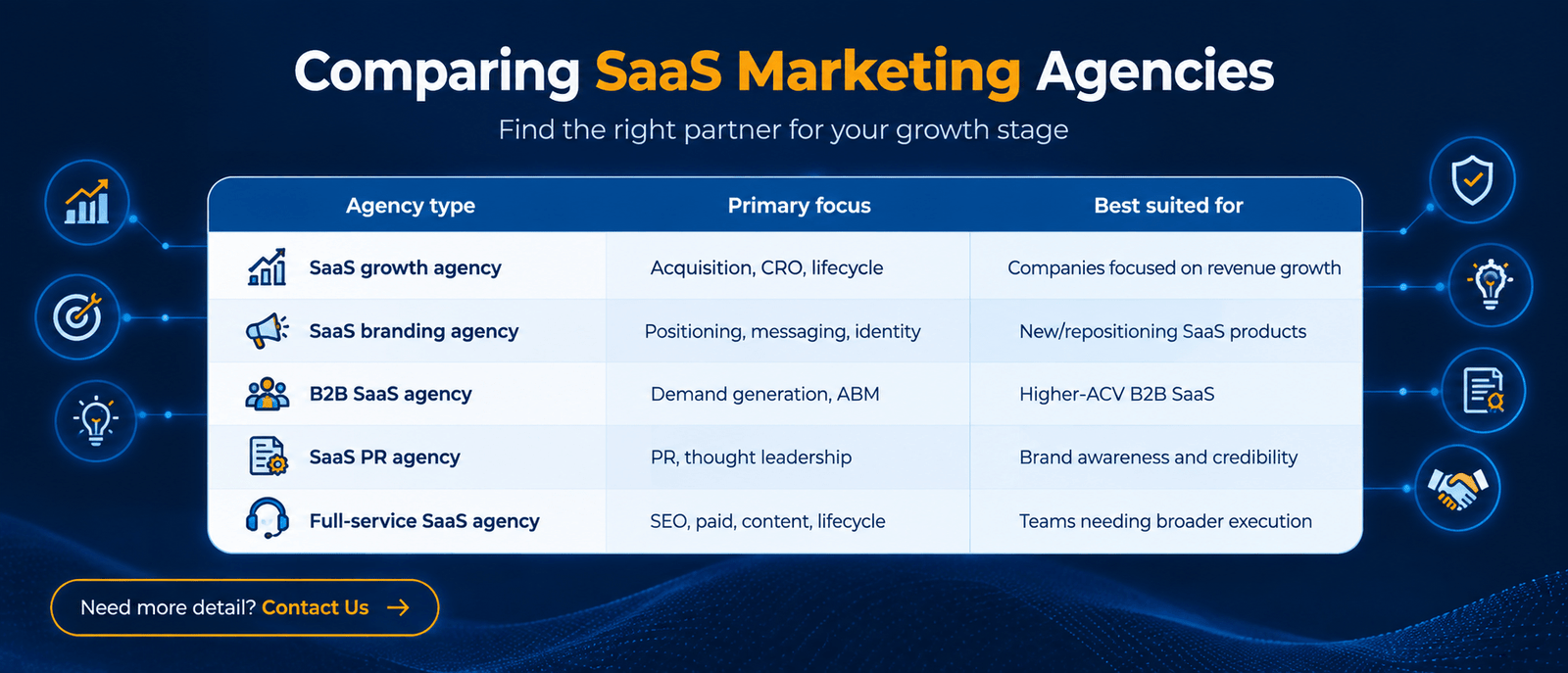
- A saas growth marketing agency or saas growth agency focuses on full-funnel experimentation — paid, lifecycle, and conversion rate optimization aimed squarely at pipeline and revenue growth.
- A saas branding agency or saas creative agency owns visual identity, messaging, and positioning — the foundation everything else builds on.
- A b2b saas agency or b2b saas marketing agency typically runs ABM, LinkedIn, and sales-aligned demand generation for longer, higher-ACV sales cycles.
- A saas pr agency focuses purely on earned media, analyst relations, and founder thought leadership.
- A general digital marketing agency for saas or marketing agency saas provider may offer a fuller mix — SEO, paid, and content — under one roof, which suits earlier-stage companies that need broad coverage before they can afford specialist retainers.
How to Choose the Best SaaS Marketing Agency
With no shortage of vendors calling themselves the best saas marketing agencies or top saas marketing agencies, use a structured checklist rather than a pitch deck to decide:
- SaaS-specific case studies. Ask for MRR, CAC, or NRR movement — not just “traffic growth” — from past digital marketing for saas companies engagements.
- Understanding of your metrics. They should ask about your churn, LTV:CAC, and activation numbers in the first call, not just your keyword list.
- Channel depth vs. breadth. Decide whether you need a specialist (e.g., pure ABM) or a generalist saas marketing firm that can run multiple channels as you scale.
- Reporting cadence tied to revenue, not vanity metrics.
- Team continuity — who will actually work on your account day to day, not just who’s on the sales call.
Among the best b2b saas marketing agencies, the strongest common trait is a willingness to say no to channels that don’t fit your ICP rather than upselling every service in their offering. The same discipline applies whether you’re comparing top marketing saas companies for a full retainer or just sourcing a single specialist for PR or paid media.
FAQs
What is SaaS marketing?
SaaS marketing is the strategy and execution used to acquire, activate, retain, and expand customers for subscription software products, spanning SEO, content, paid acquisition, product-led growth, and lifecycle email.
How is SaaS marketing different from regular digital marketing?
SaaS marketing is judged on lifecycle metrics — activation, retention, net revenue retention, and churn — rather than just traffic or lead volume, because recurring revenue depends on ongoing product usage, not a single transaction.
What channels work best for B2B SaaS marketing?
Content and SEO, paid search, LinkedIn/ABM, and email automation consistently perform best for B2B SaaS, with the right mix depending on average contract value and sales cycle length.
How much should a SaaS company spend on marketing?
Spend varies by stage and growth targets, but many SaaS companies allocate somewhere between 15–30% of revenue to sales and marketing combined during active growth phases, tightening as the business matures.
When should a SaaS company hire a marketing agency instead of hiring in-house?
When in-house teams lack a specific specialist skill set (technical SEO, ABM, PR), when growth targets outpace current headcount capacity, or when leadership needs an outside diagnostic view on stalled metrics like churn or CAC.
What metrics should I track for SaaS marketing?
CAC, LTV:CAC ratio, CAC payback period, MRR/ARR, net revenue retention, churn rate, and activation rate are the core metrics that connect marketing activity to business health.
Conclusion
SaaS marketing isn’t a single campaign or channel — it’s a system that has to work across acquisition, activation, retention, and expansion at the same time. Get the ICP and positioning wrong, and even the best-executed SEO or paid campaign will leak revenue at the next stage of the funnel. Get AI search visibility wrong, and you become invisible exactly as buyer research habits are shifting away from traditional search. The SaaS companies winning in 2026 aren’t necessarily spending the most — they’re the ones treating marketing as a lifecycle discipline, with every channel tied back to CAC, NRR, and churn, not vanity metrics.
That’s precisely the gap most in-house teams hit: they can run individual channels, but connecting SEO, paid, ABM, and lifecycle email into one system tuned to SaaS metrics takes bandwidth and pattern recognition most teams don’t have time to build alone.
CTA
Ready to turn your SaaS marketing into a revenue system, not a set of disconnected campaigns?
At Digital BizStar, we work with B2B software and technology companies to build full-funnel marketing programs — SEO and content built for both traditional and AI-driven search, paid acquisition, ABM, and lifecycle email — all mapped to the metrics that actually matter: CAC, NRR, and churn.
👉 Get a free SaaS marketing audit and see exactly where your funnel is leaking revenue
Book your free consultation with Digital BizStar today