 +91 7550360374
  info@digitalbizstar.com
Industrial Marketing SEO
Industrial buyers often spend weeks researching products, suppliers, and technical specifications before making a decision. Their journey typically starts with Google and increasingly includes AI search tools.
Industrial Marketing SEO helps manufacturers reach engineers, procurement teams, plant managers, and other decision-makers during this research process. It combines Manufacturing SEO, B2B SEO, and Account-Based Marketing (ABM) to attract high-intent buyers and generate qualified opportunities.
“Who Is This Strategy For?”
This would make the article more relevant to your target market.
For example:
This strategy is ideal for:
- Industrial equipment manufacturers
- Engineering companies
- CNC machining companies
- Industrial automation companies
- Special-purpose machinery manufacturers
- Electrical and electronics manufacturers
- Metal fabrication companies
- Conveyor manufacturers
- Robotics companies
- B2B industrial suppliers
This also gives you opportunities to naturally mention your target industries.
Why Generic B2B SEO Doesn’t Work Well for Industrial Companies
Much of the SEO advice available online is designed for SaaS companies, ecommerce businesses, or consumer brands.
When the same approach is applied to industrial companies, it often focuses on the wrong things:
- Getting more traffic instead of attracting qualified engineers and buyers
- Targeting individual decision-makers instead of buying committees
- Producing short, general content instead of detailed technical information
Industrial SEO is different for three main reasons.
1. The Buying Committee Matters More Than One Buyer
Industrial purchases often involve five or more stakeholders.
Engineering, operations, procurement, quality, finance, and management may all influence the final decision.
Each person searches differently and looks for different information.
2. Industrial Search Is Driven by Specifications
Industrial buyers usually search for specific technical information rather than general marketing messages.
For example, they may search for:
- “ATEX-certified pneumatic actuator”
- “SS316 vs SS304 corrosion resistance”
- “5-axis CNC machining 6061-T6 aluminum”
- “precision machining ±0.005 inch tolerance”
In industrial SEO, search relevance and technical accuracy are often more valuable than search volume.
3. Authority Matters More Than Impressions
Industrial sales cycles can last for months.
A single technical article may be read by an engineer today, shared with procurement next month, reviewed by management later, and eventually contribute to an RFQ.
This makes simple last-click attribution less useful.
Your SEO strategy should therefore focus on:
Who is searching + What are they searching for + Where are they in the buying process?
Step 1: Map Content to Your Buying Committee
Don’t start SEO with keywords alone.
First, identify the people involved in your buying process and understand what each person needs.
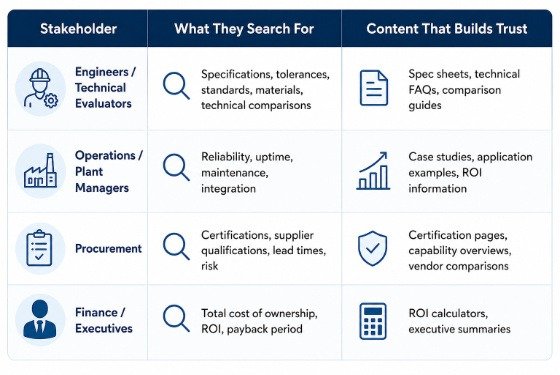
This approach does two important things.
First, it prevents you from creating one generic page that tries to satisfy everyone.
Second, it helps you identify content gaps.
For example, many industrial websites provide excellent technical information for engineers but very little content explaining ROI, cost savings, or business value for finance and executive decision-makers.
That gap can slow down deals even when the technical evaluation is already complete.
Step 2: Build Keyword Research Around Specification Language
Industrial keyword research should start with your products, processes, and customer conversations — not just a keyword tool.
Look at the actual language buyers use, including:
- Part numbers
- Material grades
- Tolerances
- Certifications
- Industry standards
- Manufacturing processes
- Application requirements
- Technical problems
For example:
Instead of targeting only:
“Precision CNC machining”
also explore more specific searches such as:
“5-axis CNC machining 6061-T6 aluminum ±0.005in tolerance”
The more specific search may have lower volume, but the person making that search is likely to have a much stronger buying intent.
A Practical Industrial Keyword Research Process
1. Talk to your sales team
Review CRM notes, RFQs, customer questions, and support tickets.
These often contain the exact words customers use when describing their requirements.
2. Use Google Autocomplete and People Also Ask
Enter your main product, process, and material terms into Google.
Look at:
- Autocomplete suggestions
- People Also Ask questions
- Related searches
These can reveal long-tail topics and questions that buyers are actually searching for.
3. Use keyword research tools
Tools such as Ahrefs and Semrush can help evaluate:
- Search volume
- Keyword difficulty
- Search trends
- Related keywords
- Competitor rankings
However, don’t let search volume become your main decision-making factor.
A low-volume keyword with strong buying intent can be more valuable than a high-volume generic keyword.
4. Organize keywords by buying stage
Divide keywords into different stages of the buyer journey.
Problem-Aware
The buyer knows there is a problem but may not know the solution.
Example:
“Why do parts warp during machining?”
Solution-Aware
The buyer is comparing possible solutions.
Example:
“Laser cutting vs waterjet cutting”
Vendor-Aware
The buyer is looking for a supplier.
Example:
“[Process] supplier for aerospace”
The objective isn’t to create the biggest keyword list.
The objective is to create a keyword list where every important search connects to a real buyer, buying stage, product, service, or business opportunity.
In many industrial markets, A smaller set of highly relevant technical keywords can often deliver more qualified opportunities than a large set of broad keywords.
Step 3: Make Capability Pages Your Main Conversion Assets
Blogs are important for building authority and attracting search traffic.
But for industrial companies, capability and service pages are often where RFQs actually happen.
Your capability pages should work more like technical resources than traditional brochures. A strong Website Design & Conversion Optimization strategy also helps turn these technical pages into effective conversion assets.
Each page should clearly explain:
- What the process or service does
- Materials you work with
- Industries served
- Machine capabilities
- Tolerance ranges
- Production volumes
- Prototype-to-production capabilities
- Relevant certifications
- Technical specifications
- Applications
Your pages should also include structured data where appropriate so search engines can better understand products, FAQs, and other information.
Most importantly, provide a clear next step.
Instead of using only a generic:
“Contact Us”
consider more specific CTAs such as:
- Request a Quote
- Upload CAD File
- Talk to an Engineer
- Get Technical Consultation
Use Blogs to Support Capability Pages
Your blog should not compete with your capability pages.
Instead, it should guide readers toward them.
For example, an article about:
“How Tight Tolerances Affect Machining Cost”
could naturally link to your:
Precision CNC Machining Capability Page
This creates a clear path:
Search → Technical Content → Capability Page → RFQ
Step 4: Don’t Ignore Technical SEO
Industrial websites often have technical SEO challenges that consumer websites don’t face.
Many companies have:
- Large product catalogs
- Thousands of SKUs
- PDF-heavy websites
- Old CMS platforms
- Technical specification sheets
- Duplicate product information
- Complex navigation structures
These issues can prevent search engines from properly crawling and indexing your most valuable pages.
Key Technical SEO Areas to Audit
Crawlability and Indexation
Make sure important product and capability pages can be:
- Crawled
- Indexed
- Discovered through internal links
This becomes especially important when your website contains thousands of products.
Site Speed and Mobile Usability
Industrial buyers increasingly research suppliers using mobile devices, including while working on the shop floor.
Your website should therefore load quickly and work properly on mobile devices.
Structured Data
Use appropriate structured data for:
- Products
- FAQs
- Organizations
- Other relevant business information
Well-structured information can help search engines and AI systems better understand your website.
Clean URL Structure
Use simple, descriptive URLs.
For example:
Better:
/capabilities/laser-cutting/
Instead of:
/product?id=4587&category=12
Optimize PDFs and Specification Sheets
PDFs and technical datasheets are often some of the most downloaded resources on industrial websites.
However, they are frequently overlooked in SEO.
Optimize them by using:
- Descriptive filenames
- Relevant titles
- Search-friendly text
- Proper headings
- Internal links where appropriate
- Useful metadata
Consider a PIM for Large Product Catalogs
If your company manages thousands of products, a Product Information Management (PIM) system may be worth considering.
A PIM can centralize product information and make it easier to maintain consistent product data and on-page optimization across a large catalog.
Step 5: Extend Your Strategy to AI Search — AEO/GEO
Industrial buyers are increasingly using AI tools during the research process.
This includes platforms such as:
- ChatGPT
- Google AI Overviews
- Gemini
- Perplexity
This creates another opportunity for industrial companies: AI Search Optimization, often referred to as Answer Engine Optimization (AEO) or Generative Engine Optimization (GEO).
The good news is that you don’t necessarily need a completely separate strategy.
Strong technical SEO provides much of the foundation.
Make Your Content Easy for AI Systems to Understand
Focus on:
- Clear and structured content
- Question-and-answer formats
- Accurate technical information
- Well-organized specifications
- Appropriate schema markup
- Consistent facts across your website
For example, if your website says one tolerance range on your product page and a different tolerance range in a PDF, that inconsistency can create confusion.
Make sure important facts are accurate, consistent, and easy to verify.
AI search should therefore be treated as an extension of your existing SEO and content strategy.
Companies already publishing specific, technically accurate, well-structured content are in a stronger position to appear in AI-generated answers.
Step 6: Build Authority in Ways Industrial Buyers Trust
Off-page SEO for industrial companies should not be about collecting random backlinks.
Industrial buyers want evidence that your company is legitimate, capable, and trusted within its industry.
Focus on relevant industry sources such as:
- Industry directories and databases
- ThomasNet
- GlobalSpec
- Engineering360
- Kompass
- DirectIndustry
- Industry associations
- Certification directories
- Vendor approval listings
- Client case studies
- Industry publications
Certifications and Associations
Where relevant, maintain accurate listings for:
- ISO certifications
- Industry associations
- Approved vendor directories
- Relevant professional organizations
These can strengthen both credibility and online authority.
Client Case Studies
Ask customers to publish case studies where appropriate.
A customer-published case study that naturally references and links to your company can provide both credibility and a valuable relevant link.
Technical Guest Content
Contribute genuinely useful technical articles to relevant industry publications.
Avoid low-quality promotional content.
Instead, publish practical information such as:
- Technical explainers
- Material comparisons
- Process guides
- Engineering insights
- Application-focused articles
LinkedIn Distribution
LinkedIn Marketing can also play an important role in distributing technical content and reaching industrial decision-makers.
When engineers, technical experts, and industrial buyers share useful content, it can increase visibility and potentially generate natural mentions and links.
Local and International SEO for Industrial Companies
If your company serves multiple locations, regions, or countries, don’t overlook geographic SEO.
For local facilities, maintain an accurate Google Business Profile and consistent business information.
For international manufacturers, consider:
- Proper hreflang implementation
- Country-specific pages
- Market-specific content
- Local terminology
- Local search intent
Avoid simply translating the same page word-for-word for every market.
Different countries may use different terminology, standards, purchasing processes, and search behavior.
Step 7: Measure What Actually Predicts Revenue
Analytics & Growth Reporting helps connect SEO activity with qualified engagement, RFQs, and pipeline. Traffic alone doesn’t tell you whether industrial SEO is working.
Because industrial sales cycles are long and involve multiple interactions, your measurement strategy should focus on pipeline and buyer engagement, not just pageviews.
Important Industrial SEO Metrics
1. Qualified Engagement
Track actions such as:
- Spec-sheet downloads
- CAD downloads
- Time spent on capability pages
- Return visits
- Technical content engagement
If possible, identify whether visitors from the same company return multiple times.
2. Priority Keyword Movement
Track rankings for your most important buyer-intent and technical keywords.
Don’t focus only on the total number of keywords ranking.
3. RFQs and Quote Requests
Track which pages generate:
- RFQs
- Quote requests
- Contact form submissions
- Phone calls
- Other qualified leads
URL-level tracking can help you understand which content contributes directly to opportunities.
4. Multi-Touch Attribution
An industrial buyer may interact with five or ten pieces of content before submitting an RFQ.
Your measurement system should give credit to the early-stage content that helped educate the buyer — not only the final page they visited before submitting the form.
5. Customer Lifetime Value
Compare customer lifetime value across acquisition channels.
Content-educated buyers may become valuable long-term customers because they already understand your capabilities and expertise.
What Success Looks Like
Don’t assume SEO has failed simply because traffic growth is modest.
If several of these metrics are improving quarter over quarter:
- Qualified engagement
- Priority keyword rankings
- RFQs
- Quote requests
- Pipeline contribution
- Customer value
then your industrial SEO strategy may be working exactly as intended.
This is especially true in niche industrial markets where the total search audience is smaller but the value of each qualified buyer is much higher.
Common Industrial SEO Mistakes
Even companies investing in SEO can unintentionally limit their results.
1. Chasing Search Volume Instead of Relevance
A keyword such as:
“industrial equipment”
may have high search volume.
But a highly specific search related to your actual capability may produce far more qualified leads.
Focus on relevance and buying intent, not volume alone.
2. Creating One Page for Everyone
Engineers, procurement managers, plant managers, and CFOs don’t need the same information.
Trying to satisfy everyone on one page often means nobody gets the information they really need.
Create content for specific audiences and buying stages.
3. Treating Industrial Content Like B2C Content
Industrial buyers care about:
- Specifications
- Compliance
- Reliability
- Performance
- Total cost of ownership
- Certifications
- Integration
- Risk
Lifestyle content, emotional hooks, and seasonal trends usually don’t have the same importance.
Your content should reflect how industrial buyers actually evaluate suppliers.
4. Publishing Only Occasionally
Publishing one technical article every few months makes it difficult to build topical authority.
Consistent technical publishing gives you more opportunities to target:
- Long-tail keywords
- Buyer questions
- Product applications
- Technical problems
- Comparison searches
Regularly reviewing and updating older content is also important.
5. Ignoring Technical Debt
Content cannot compensate for a website that is:
- Slow
- Difficult to crawl
- Poorly structured
- Full of duplicate pages
- Blocking important content from search engines
Technical SEO and content strategy need to work together.
Bringing the Industrial SEO Strategy Together
Industrial marketing SEO isn’t simply traditional B2B SEO with a few technical keywords added.
It is built around the specific way industrial buyers research and purchase.
A successful strategy connects:
Buying Committees
↓
Specification-Based Keyword Research
↓
Technical & Educational Content
↓
Capability & Product Pages
↓
AI Search Optimization
↓
Industry Authority & Trust
↓
Qualified RFQs & Pipeline
The strongest industrial SEO strategies:
- Map content to different stakeholders
- Use real customer and specification language
- Target high-intent technical searches
- Turn capability pages into conversion assets
- Use blogs to support service and product pages
- Fix technical SEO issues
- Optimize content for AI search
- Build authority through relevant industry sources
- Measure RFQs and pipeline instead of traffic alone
The manufacturers gaining an advantage today aren’t necessarily the largest companies.
They are often the companies that consistently publish specific, technically accurate, useful content that matches exactly how their buyers search.
While competitors continue chasing broad search volume, these companies are building visibility around the searches that actually influence industrial purchasing decisions.
That’s the real opportunity in industrial marketing SEO for 2026.
Digital BizStar helps manufacturers turn that opportunity into measurable growth through Manufacturing SEO, AI Search Optimization, technical content, website optimization, LinkedIn Marketing, and performance analytics.
How Digital BizStar Helps Manufacturers Grow Through SEO
Digital BizStar helps manufacturers improve search visibility, reach qualified industrial buyers, strengthen AI search presence, and generate more qualified RFQs through Manufacturing SEO, AI Search Optimization, content, website optimization, LinkedIn Marketing, and analytics.
Want More Qualified RFQs From Search?
Digital BizStar helps manufacturers build search strategies that attract engineers, procurement teams, and industrial buyers.